Educational Multimedia Support
Website: http://www.cimwareukandusa.com
Email: cimware@cimwareukandusa.com
NJIT, New Jersey Institute of Technology
Newark, University Heights, NJ07102-1982, USA
Email comments to: ranky@admin.njit.edu
or Email at the Publishers: cimware@cimwareukandusa.com
Please note, that this support section of our web page gradually changes and develops as new ideas, validated results and needs emerge...
There is a need to examine the human input to the creation and application of know-how in its widest sense, since know-how is important in our everyday life, in our efforts of exploring nature and our environment, as well as in our business and management success.
This work on Engineering Multimedia urges the development of anthropocenic systems in which humans and machines work in harmony, each playing the appropriate and affordable (i.e. the best possible) role for the purpose of creating intellectual as well as fiscal wealth. This means creating a better educated workforce, at all levels, by building on existing skills, ingenuity and expertise, using new science and technology-based methods and tools, such as interactive multimedia.
Today, and in the forthcoming decade of our IT revolution, science and technology in combination can create an intellectually exciting environment that molds human creativity, enthusiasm, excitement and the underlying curiosity and hunger to explore, learn and create and then learn again. Unfortunately, in many minds, and even in many countries engineering science and technology is not considered to be culturally and socially as acceptable as e.g. law, accounting or banking. On the other hand, it is obvious that economic development is not a unidimensional process that can be measured by a narrow view of conventional accounting.
Consequently there is a need to develop new creative and stimulative multimedia-based infrastructures, products and means of production that can meet challenges now faced by many companies and even countries as natural resources become more scarce, the environment becomes more polluted and major demographic changes and movement of people is taking place.
The fundamental change, that has to be recognized, is that most existing hi-tech systems were designed with the human operator playing a passive, "downgraded" role, and a machine being the "clever" component in the system. This is because accountant driven management considers the workforce to be a major cost item instead of a major asset!
Today, many advanced systems are only considered to be "scientifically engineered" if they are dominated by the predominant characteristics of predictability, repeatability and mathematical quantifiability! (Unfortunately this is not always feasible. As an example, try to create the set of mathematical equations defining the best possible automobile design, from road-holding to upholstery - all of it! Difficult?)
By definition the above introduced narrow view precludes intuition, subjective judgment, imagination, "touch and feel", the senses and intentionality. This must be changed. Unfortunately it takes a long time to implement this change...
Anthropocentric technologies, such as flexible, interactive multimedia make the best use of science and technology, driven by the user at his or her pace and time, enabling the learner to explore and implement concepts further than that of the accountants order-bound fiscal view. Consequently, interactive multimedia does not mean declaring war, but a new opportunity to put back humans into harmony with nature and "able" machines, by being better informed, better educated and happier contributors, rather than efficient long-term waste creators and destroyers of nature and the society.
Interactive multimedia combines and integrates text, graphics, animation, video and sound in a flexible way. It enables learners to extend and enhance their skills and knowledge working at a time, pace and place to suit them as individuals and/or teams and should have a range of choices about the way they might be supported and assessed.
In other words:
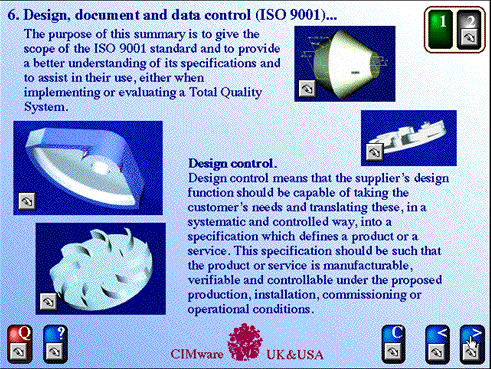
Note this screen copy (shown below) of one of the 700 plus screens of our "An Introduction to Total Quality Management and Control and the ISO9001 International Quality Standard" CD-ROM title. The photo icons open up to full screen images upon clicking on them and the controls on the screen are all driven by clicking with the mouse. (Consequently, the package takes less than a minute to learn.) Note, that although not shown on this particular screen, there are over 45 minutes of interactive digital videos on this CD-ROM!
We are living in an era when competitive advantage cannot be maintained without continued and sustained commitment to innovation, research and development and high-quality, student-centered, flexible, multimedia-based Open/Distance Learning.
In terms of corporate investment, the financial stake involved in turning good quality, flexible, Open Access Education and research into competitive advantage is enormous. As many examples show in Europe, United States, Japan, Asia and elsewhere, entire nations' future and wealth (both intellectual and material) depend on the quality of education provided to learners. This means that the wrong education, research and development strategy for product design, manufacture and management can easily spell disaster.
Consequently flexible, Open Access Education and multimedia, or hypermedia technology must be managed as a strategic resource for competitive advantage. In a similar way we must deal with flexible manufacture, to cut batch sizes to one and Computer Integrated Manufacture (CIM), or Creative and Innovative Manufacturing and Design, to provide an efficient and well-integrated communications, procurement, design, manufacturing, test, etc. infrastructure ([1], [2], [9], [16] and [18]).
Our main educational objective is to support the new, multifaceted, dynamically changing learning experiences that real life imposes on us and on our lifetime learners.
We have to recognize that traditional, mass-produced, highly-controlled static and rigid educational methods cannot cope with the increased amount of information, knowledge and inferencing requirements of this rapidly changing world!
The life cycle of critical design and manufacturing technologies is increasingly contracting. Concepts such as time to market, total quality management, local design, global manufacture, concurrent or simultaneous engineering, parallel design and manufacturing, intelligent design and intelligent manufacturing systems are widely accepted. These new technologies require multi skilled and well-educated engineers and managers as well as flexible, and feedback controlled manufacturing technologies, such as cellular manufacture, CIM, Concurrent Engineering and FMS ([1], [2], [5], [6] and [17] to [23]).
It is important to recognize that we are living in an era when the customers, not the designers or salesmen, are the kings. Customers require increasingly better products at a lower cost. In other words, products require continuous improvement and change, therefore flexible design and manufacture, and the appropriate level of automation, must be provided throughout the life cycle of product development.
In the education business the customers are the learners, i.e. students entering access courses, college and university courses, mature students who are prepared to study in the evenings at home, at the University, or in Open / Distance Learning Centers. Furthermore, there are a large number of continuing education (i.e. mature, nontraditional) students and other professionals seeking new focused knowledge in this rapidly changing and extremely competitive world.
Advances in computers have provided exciting opportunities in Desktop Publishing and Desktop Design, but we are entering now into a new era of Desktop Education and Training, Desktop Design & Manufacturing and Desktop CIM & Concurrent Engineering. The fundamental reason for this is that talented engineers find it extremely pleasing to cut down waste and rapidly create new products and machines to fabricate new products using the growing computing power, the small scale kit-based machinery, small CNCs, robots, etc. - all on the top of their desks!
There are many methods and solutions to cut down waste and to improve an organization, a design office, a manufacturing enterprise, or a product. It is important to note that, whatever we call it, CIM, Concurrent or Simultaneous Engineering, or JIT (just-in-time) means getting rid of waste, organizing our knowledge in our minds, and integrating the information flow, the material flow and the processes in our factories in order to create wealth. In other words, CIM and Concurrent Engineering address the whole enterprise, including the business systems, product design, process planning, manufacturing planning, the shop floor, packaging, maintenance and others.
In order to cut waste successfully and create new wealth it is necessary to deal with various types of system modeling, design, rapid prototyping, Desktop CIM and other methods and technologies. The most important issues in this context include the following:
In order to succeed, new management methods are also needed. The "event driven, networking company" as opposed to the traditional, "do everything yourself, control centrally... and loose valuable time" approach is past. Management by objectives is a frequently used technique where able employees are guided by means of clear objectives rather than rules, regulations and military-style, restrictive, rather than creative management solutions.
Teamwork is crucial too. Designers, Manufacturing, Marketing, Quality and Maintenance Engineers and the Customers working together to achieve joint success is critical. Desktop CIM and multimedia in this respect represent excellent training, rapid prototyping as well as validation tools.
To summarize, there is a need for more freedom, more openness, better overall communication and understanding between designers, marketing, quality and manufacturing engineers and the customers. Desktop CIM and Concurrent Engineering with multimedia supports this systematic approach to the integrated, concurrent design of products and their related processes, including manufacture and support. These methods are intended to cause developers, from the outset, to consider all elements of the product life cycle from conception through disposal, including quality, cost schedule and user requirements.
Open, student centered learning is a flexible, multimedia based and efficient extension to (i.e. not replacement of) the traditional lecture type, or workshop and laboratory based training and education. It enables learners to extend and enhance their skills and knowledge working at a time, pace and place to suit them as individuals and/or teams and should have a range of choices and sequences about the way they might be supported and assessed.
In other words, Open/ Distance Learning means that the student
Based on international experience, good Open / Distance Learning programs offer:
Open Learning includes those situations where the learning occurs at a distance ("Distance Learning"), as well as where learning occurs without this being the factor for the learner and tutor ("telepresence").
Open/ distance learning offers major benefits, and some disadvantages (as can be seen later) to Learners (i.e. students), Tutors (i.e. lecturers and instructors), Sponsors (i.e. employers and managers) and Educational/Training Organizations (i.e. Colleges, Universities, Training Centers, Professional Bodies, or Private Enterprises).
Consider the power of clicking on and then playing several different interactive, digital videos - as shown in the captured screen below. (This a method and technology we refer to as: "interactive object hopping").
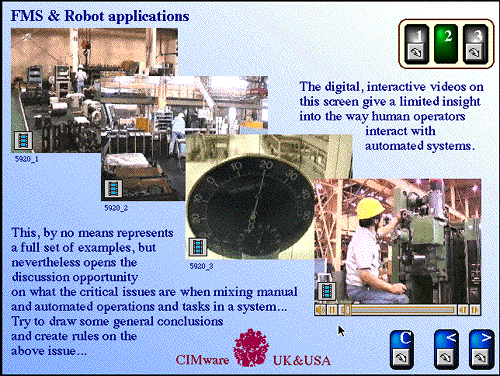
The combined results of independent surveys conducted by the University of Abertay Dundee (Scotland), by the University of East London (England), and by NJIT (New Jersey Institute of Technology, USA) support the above listed benefits of multimedia and open learning in general. Based on the responses, it is obvious that both students as well as academics have rated interactive multimedia to be the top of the list of advanced learning tools, in comparison to traditional methods, such as wall charts, the blackboard, overheads and others.
As an example, consider that if you need a few interesting photographs of robots and flexible manufacturing cells as well as some digital videos (that would be very slow using the Internet), for a presentation or assignment you could use your word processor, or a simple 2D drawing tool and copy and paste this material from your CD-ROM into your own document. (With all respect, be warned, that this technique works with nonprofessional multimedia authoring tools only if the overall file size is relatively low!)
There are some difficulties that have to be faced when introducing Open Learning and Multimedia systems. These include cost, lack of student motivation, student overload, increased marking/grading load, self-assessment and new organizational structures for lectures/instructors, laboratories and courses.
Besides the above listed points, the cultural and human resistance to accept change in a traditional education system can be very difficult to overcome and will most likely cause the most problems in the long run.
In order to paint the most realistic picture, let us discuss some of the key problems one should resolve when introducing interactive multimedia in practice.
Concern: Dr. A.N. OTHER instructor claims: "I am afraid of the new technology, such as interactive multimedia, because it means more cables, more boxes and equipment that I don't quite understand and that must work together - and if it doesn't, "the show is over"... and what am I going to do then?"...
Solution: There is no doubt that Computer Based Interactive Multimedia is more complex, than that of the blackboard!... or a set of OHs... but then it offers more too, because it moves and talks and it is direct access (i.e. nonlinear)! Furthermore, good multimedia is easy to use as long as you can click with the mouse... new, reputable equipment is reliable and although one has to carry more boxes to conferences, in a classroom environment there should be several computers capable of doing exactly the same task - so it will work! The key is that one should be prepared! And of course practice makes the master - so practice! It is fun!
Concern: Dr. A.N. OTHER instructor claims: "Movies can be destructive, because they drag the student's attention away from the science content of the presentation.."
Solution: There are many good and many bad digital movies on CD-ROMs, but you should keep in mind, that you don't have to play them if they are bad. Furthermore good multimedia practice enables the user to control (i.e. start, stop, fast-forward, rewind, select, play frame-by-frame, etc. the digital videos). The big advantage of digital video is that it can be searched and found quickly and that it can be controlled with the mouse.
Concern: Dr. A.N. OTHER instructor claims: "Movies are small. I would prefer full screen images..."
Solution: Wouldn't we all... There are hardware and software solutions for this; most notably there is Apple's excellent cross-platform compatible QuickTime solution, which is the international software only standard, as well as there is MPEG, which is a more expensive hardware and software extension. Furthermore note that good quality, full screen video is possible only when the data transfer rates and the processing speeds are high! Meaning, that only the latest computers could do it. Since most CD-ROMs are designed for individual viewing, we prefer good quality versus size!... An LCD panel does the job when a small size video is projected for class, but one should keep in mind, that most (not all) LCD panels do not project more than 256 colors in 640x480 resolution, which is poor, compared to 600x800 resolution and thousands of colors; the ideal setting for most multimedia CDs.
Concern: Dr. A.N. OTHER instructor claims: "There are several poor quality images on the CD-ROM. Can I improve them?"
Solution: The problem in most cases is in the way the CD-ROM is run on the particular screen, or projected. Unfortunately there are many people who cannot identify the resolution of their screens, or change, or set better resolutions and thousands of colors (16 bit) on a computer screen. This takes a few seconds on the Mac, and is reasonably simple in Win95 too, although with Windows one needs to reboot the entire system to activate the new settings - which is a pain...
The other problem is that many people don't know how to scan in images properly, how to touch them up with professional packages and then how to integrate them in different graphics formats into different documents... The space is short to discuss and answer these issues here, but nevertheless one should keep these important issues in mind and seek professional help.
Concern: There are classroom problems in terms of the layout of the classroom, the lights, the screens, the screen projection system, and with other local facilities
Solution: Most classrooms can be converted to a simple, low cost multimedia facility. Simplicity, good will and strong desires can create wonders... this is important if one's pocket is empty. The aim should be to be able to run interactive multimedia for the students on individual PCs and Macs and have at least one machine with a projection system, or a large screen for group demonstrations. Internet link is desirable as a minimum on one machine, but preferably on all to take advantage of the latest concepts of linked CD-ROM/Internet learning sessions.
Concern: Many academics claim: "Multimedia is great, but I don't want to become a software expert to put it all together... "
Solution: There are professional experts out there who can help. Subject area specialists should focus on their resource material and on what they want to communicate and teach - not on the multimedia authoring... although many would like to have a go at it, and this should be encouraged, even if it takes years of hard work to make it happen!
Concern: "The Internet will do everything for us, consequently we don't need CD-ROMs and DVDs"
Solution: As with new technologies, many people intend to believe, that one technology will resolve all of their problems. This is of course not true, even if the technology we are talking about is the amazing Internet! The core issue is transfer rate and bandwidth, as well as the cost of data storage (i.e. 650 Mbytes and more...). Although there are constantly emerging new technologies in the area of compression, streaming, etc. the truth is, that the Internet to the majority of th eusers is still extremely slow (i.e. several hundred times slower) than a reasonable speed CD-ROM, thus something that would take one second using a CD-ROM could easily take 4-5 hours (!) on the Internet. Because of this, the logical solution is to store real-time changing information on the web and longer term, more static, large files e.g. good quality videos, photos and large, integrated shows on CD-ROM.
For basic comparison consider the following interesting technical data: a relatively slow Internet 14.4 modem pushes through (theoretical max.) 1.8 Kbytes/second, a 28.8 ("faster" modem) max. 3.6 Kbytes/sec (in practice one can achieve typically around 2.1- 2.6 Kbytes/sec depending on network trafic) and an even faster ISDN (Integrated Services Digital Network) modem 16 Kbytes/sec. The out-of-date and slow, or just about adequate 2xCD-ROM will push through 300 Kbytes/sec and the more reasonable 8xCD 1200 Kbytes/sec. More recent CDs push through 3600 Kbytes/sec (24x), which is close to a slow to medium magnetic hard disk transfer rate. (A good hard disk can handle over 10Kb transfer rates). The DVD (Digital Variety Disk) has a typical transfer rate of 2700 (18x) to 3000 (20x) Kbytes/sec transfer rate and stores over 17 Gigabytes of data (current CD-ROMs can store max. 650 Mbytes).
Modern, multimedia based Open/ Distance Learning material have the following characteristics:
Interactive multimedia-based education systems can be complex to develop because they have to deal with humans as well as machines simultaneously. In other words, education systems and products created for such systems have to deal with many different dynamic system components and resources simultaneously. To satisfy the advanced educational system development requirements we have created a generic, structured model on Open & Distance Learning material and multimedia course development.
CIMpgr process definition and explanation
(Please click on this image to view it enlarged)

CIMpgr process definition
(Please click on this image to view it enlarged)
According to the basic object oriented model, as illustrated in the Figures above, the input to any educational system consists of target or potential learners, and their initial information and knowledge at the entry point of the educational, or training process. Furthermore it is necessary to acknowledge the support and influence given by the tutors, and the society who are prepared to do their best in facilitating and managing the information input as well as the learning process ([62], [64] and [69]).
The purpose of the entire process, of course, is to gain experience, knowledge and, eventually to create wealth for the learners and tutors as well as for the society as a whole. This is shown as the output in our model.
To turn the given input into the desired output, a process is required, identified as the "learning process and/or the educational experience, and/or the Open / Distance Learning material development process..." in our case. This process naturally needs enabling methods, tools and technologies, such as authoring tools and multimedia hardware and software to fire, provided as resources by the training organization, or university, but is also constrained by certain restrictions or controls, such as time, budget and technology. These are identified as generic objects in our model.
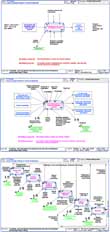
Our object oriented distance learning and multimedia development model in CIMpgr
(Please click on this image to view it enlarged)
It must be noted that all CIMpgr models must have a Purpose and a Viewpoint specification. As previously noted, the purpose of the model is to provide a generic methodology to structured Modular, Open & Distance Learning material and multimedia course development. The viewpoint are that of the system analyst's and the system designer's, who are developing, implementing and integrating the entire system. A model could have been created for example for validation only, or delivery methods, course maintenance, or quality control. The given model is generic enough to derive such specific requirements of it if required.
There is another very important issue that should not be missed. Note that the main steps, i.e. Requirements Analysis, System Analysis, System Design, Implementation and Integration, Validation & Test and last but not least Maintenance rely on each other (meaning that they are sequentially controlled processes) as well as rely on the feedback that each of them provides.
Furthermore note, that the resource and control aspects of such system developments are much better specified and illustrated using CIMpgr, because CIMpgr shows much more about the decision space around each process than any other structured method.
In the case of a real-life Open Learning product development the model should be layered further, as well as developing these processes, process descriptions, data flows, data stores, and the data dictionaries in detail in order to achieve a successful Open Learning/Multimedia product.
Educating others as well as ourselves is not a simple task. Since each of us is unique, it is necessary to find out more about us as well as about the "art and science" based methods, tools and technologies that relate to modern education. Open Learning, Open Access Flexible Learning, Distance Learning and Interactive Multimedia represent some of these methods, tools and technologies.
The world is moving away from rigid mass production systems, because industry has discovered that customers want different products that satisfy their individual or small group needs and not, as in the past necessarily those of the designer, or manufacturer.
As a recent European Commission's report on multimedia learning underlines too,
Considering the above, hasn't the time arrived to become more customer oriented in the education business too ? This will mean more distributed control, more flexibility and freedom of choice, time and pace ... and more Interactive Multimedia ([77]).
Every professional person, engineer, manager, medical doctor, lawyer, or tax accountant carries on learning throughout their lifetime. It is vital that these positive energies should be released earlier and that people are taught how to learn about themselves and to drive their own modular and flexible education requirements with much support, guidance, resources and care being provided by the education system, tutors and classmates.
This process may require a fundamental, cultural change. That is why it is so important to start to work now!. Multimedia technology and the facilities are available today but it's introduction requires cultural change. This is a significant aspect in the implementation of Open Learning & Interactive Multimedia development strategies and requires planning and care to ensure success.
I hereby would like to express my thanks to NSF (USA), NJIT, The National Council for Educational Technology (NCET, UK) for their sponsorship, The University of East London, the Enterprise Project team, the Ford Motor Company, Hitachi Seiki (UK) Ltd., FESTO (UK and USA), BYG Ltd., Denford Machine Tools, Rolls-Royce Motor Cars, HP (UK) Ltd., NEOPOST, Siemens Plessey, Marconi Instruments, and M.F. Ranky, Multimedia Design & Programming Engineer at CIMware (UK&USA), Mr. Jim Corlett at Nottingham Trent and others for their continuous support in my research, industrial and educational multimedia projects.
[1] Mager, Robert F.: Preparing Instructional Objectives, Kogan Page 1992
[2] Rowntree, Derek: Teaching Through Sel-instruction, Kogan Page, 1990
[3] Philips, Jack J.: Handbook of Training Evaluation and Measurement Methods, Kogan Page, 1990
[4] Kayfetz, Janet L. and Stice, Randy L.: Academically speaking, Wadsworth, Boston, 1987
[5] Ranky, P G: Concurrent/Simultaneous Engineering, CIMware Ltd., 1994. 264 pp.
[6] Ranky, P G: Flexible manufacturing cells and systems in CIM, CIMware Ltd., 1990. 233 pp.
[7] Martin J: Managing the database environment, Prentice-Hall, Englewood Cliffs, N.J., 1983.
[8] Scherr, A.L: Distributed data processing, IBM Systems Journal, Vol. 17, No.4, 1978. p.324-343.
[9] Hayes-Roth ed.: Building expert systems, Addison-Wesley Publishing Co., 1983
[10] Ranky, P G: A Methodology for Product Design Innovation - USA/Japan Flex. Automation Conference and Proceedings publ. by IEEE (USA/Japan), 1994
[11] Krishnaswamy, G M and Elshennawy, A K: Intelligent concurrent Engineering environment, Computers and Industrial Engineering, Sep 1993 25(Sept) 321-324p
[12] Shipley, T A and Armacost, R L: Systematic approach to new product development, Computers and Industrial Engineering, Sep 1993 25(Sept) 333-336p
[13] Bessant, J: The lessons of failure: learning to manage new manufacturing technology, Int Jnl Technology Management, 1993 8(3/4/5) 197-215p
[14] Ranky, P G: Total Quality control and JIT management in CIM, CIMware Ltd., 1990. 256 pp.
[15] Ranky, P G: Manufacturing database management and knowledge based expert systems, CIMware Ltd., 1990. 233 pp.
[16] Kaplan G and Jaikumar, R: Manufacturing a la carte: agile assembly lines, faster development cycles, IEEE Spctrum Sep 1993 30(9) 24-27p
[17] Video series on Concurrent Engineering with Case Studies, (20 tapes of modular videos with handouts and books) by CIMware, Merrow Park, Guildford, 1992-95
[18] Video series on Flexible Manufacturing Cells and Systems with Case Studies, (29 tapes of modular videos with handouts and books by CIMware, Merrow Park, Guildford, 1992-95
[19] Paul G Ranky: Solid Model Simulation of Dedicated and Flexible Assembly Systems, Annals of Production Research, Basel, 1988.
[20] Paul G Ranky: CIM Information System Modelling with Case Studies; Published by Elsevier Science Publ. B V North Holland, 1991 IFIP ed. B Z Barta and H Haugen, p. 69-88.
[21]. Paul G Ranky: A Systematic Approach to the FMS Design Problem with CIM, The Journal of Applied manufacturing Systems, Vol.4, No.2, 1991, St.Thomas Technology Press, St. Pauls, Minnesota, USA, p. 39-45.
[22] P G Ranky: Desktop design, manufacturing and CIM, in print: Assembly Automation, Bedford University Press, 1994
[23] P G Ranky: A methodology for improving factories and product designs, in print: Assembly Automation, Bedford University Press, 1994
[24] K P Crosswell and P G Ranky: Improve volume mix and appearance of painted vehicles, research paper in preparation for publication in 1995
[25] M R Knapman and P G Ranky: Design for Manufacturing for the new Jaguar V8 4 Litre aluminium cylinder block, research paper in preparation for publication
[26] P H Ashton and P G Ranky: A methodology for analysing concurrent engineering processes at Rolls-Royce Motor Cars Ltd., research paper in preparation for publication
[27] P H Ashton and P G Ranky: Concurrent engineering system design at Rolls-Royce Motor Cars Ltd., research paper in preparation for publication
[28] K L Ho and P G Ranky: A reconfigurable, flexible material handling system design, research paper in preparation for publication
[29] K L Ho and P G Ranky: The object oriented software design of a novel reconfigurable, flexible material handling system, research paper in preparation for publication
[30] P G Ranky, T Pato, H Allemann, P Reiss and A Burli: An Object Oriented Concurrent Engineering Database Design for SMEs, research paper in preparation for publication
[31]P G Ranky: The CIMpgr model of an Object Oriented Concurrent Engineering Database, research paper in preparation for publication
[32] P G Ranky, F Redha and T Pato: The CIMpgr model of the REDHA-CUT microrobot development project, research paper in preparation for publication
[33] Ranky, P G: Robot applications and FMS, one day invited seminar as part of a four week program organised for ALLIED industries by the University of Michigan, May 1988.
[34] Ranky, P G: Robotic workcell design by simulation and robot testing, invited one and a half day seminar at RPI (Rensellaer Polytechnic Institute) in Troy, New York, as part of a two week long program organised by MIT and RPI, sponsored by the National Science Foundation, USA, televised by RPI for US Universities (June 1988).
[35] CIM at Surrey - The University of Surrey satellite job. A joint lecture for IMEchE by P G Ranky and C Douthwaite, December 1989, University of Surrey, Guildford.
[36]. Ranky, P G: "Future Research and Development Trends in CIM" Seminar for Hong Kong/City Polytechnic, December 1990.
[37] European satellite broadcast live (2 hour long) open forum; State of the art in advanced manufacturing technology and the challenges for European industry,invited speakers: A. Weatherall (IBM Europe), Prof. P Sacket (CIT, UK), Prof H J Warnecke (Fraunhofer Inst. BRD) and Prof. P G Ranky (U of S, UK); 28 Nov. 1991, Paris
[38] Ranky: IMechE seminar on CIM, January 1992, Reading University, UK.
[39]Ranky: CIM research seminar in Japan on invitation in the Kyoto Research Park, CIM Centre, November 1992.
[40] Ranky, P G: A series of seminars in Switzerland and Germany at various CIM centres. Topics included: CIM modelling, concurrent engineering, CIM project management and CIM/FMS case studies (in November and December 1992)
[41] Ranky, P G: Research seminar on CIM modelling (i.e. the CIMpgr CIM methodology and toolset) in Hong Kong, March 1993
[42] Ranky, P G: Research Seminar at Lulea Technical University, Sweden, January 1994 on Concurrent Engineering and CIM
[43] Ranky, P G: Presentation at NJIT, USA on Reengineering Engineering Education, December 1994
[44] P G Ranky and P H Francis: Design and Solid Model Simulation of Generic Assembly Cells and Systems, Japan-USA Symposium on Flexible Automation, 1986, Osaka, Japan.
[45] P G Ranky: End of Arm Tool Management System for Robotized Assembly Lines, Robots West Conference, SME, Long Beach, CA, 1986.
[46] P G Ranky: An Operation Control Strategy of FMS, Providing and Quality, International Conference on Productivity Research, ICPR'87, The University of Miami, 1987. (Accepted paper for both the conference as well as for the book that was published by Elsevier, North Holand in the same time).
[47] Paul G Ranky: Real-Time Quality Control Feedback Loops in CIM Environment, Automated Inspection and Product Control Conference organised by IFS Conferences and IITRI, Chicago, 1987 (invited paper).
[48] Paul G Ranky: The Solid Model Design and Simulation of Flexible Automation Components, FAE/ESD International Computer Graphics Conference and Exposition, Detroit, Cobo Hall April 7-9, 1987 (invited paper).
[49] Paul G Ranky and Mike Wodzinski: Robot Testing and Assembly Cell Design, IEEE 1987 International Conference on Robotics and Automation, March 1987, Raleigh, North Carolina, USA (invited tutorial paper)
[50] Ranky: A comparative analysis of tool management systems for flexible machining and assembly systems, invited paper presented on the International CIM (Computer Integrated Manufacturing) Conference in 23-25 May 1988, organised by RPI (Rensselaer Polytechnic Institute), Troy, New York, USA, p 36-43, Proc. Publ. IEEE (Comp. Soc. Press), USA 1988.
[51] Invited member of the international Program Committee of the Third International Conference on CAD/CAM, Automation, Robotics and Factories of the Future, organised by General Motors and Electronic Data Systems in Southfield, Michigan, USA, 7-9 April 1997, Publ. SAE (Soc. of Automobile Eng.), SAE/ESD, International Conf. on Comp. Graphics, Detroit, Mi, USA, p.403 - 425.
[52] Paul G. Ranky: Software Engineering methodology and tools for designing advanced manufacturing systems, FACTORY 2000 International Conference in Cambridge, England, Sept. 1988, 8 p.Org. by The Inst. of Electronic and Radio Engineers.
[53] Paul G. Ranky: The Design Experience of a Modular Master Course in CIM (Computer Integrated Manufacturing), 1990 Pacific Conference on Manufacturing, 17 - 21 December 1990, Sydney and Melbourne, Australia 299-309 p. Proc. Publ. Lawrence techn. Univ and Swinburne Inst. of Technology, Australia, 1990
[54] Paul G. Ranky: A generic CIM system modelling methodology with practical examples (Computer Integrated Manufacturing), 1990 Pacific Conference on Manufacturing, 17 - 21 December 1990, Sydney and Melbourne, Australia 500-512 p., Proc. Publ. Lawrence techn. Univ and Swinburne Inst. of Technology, Australia 1990
[55] Paul G Ranky: A general solution to the FMS design problem within CIM, FAIM 91 (Factory Automation and Information Management Conference), 13-15 March 1991, Limerick, Ireland p. 158-172, Publ. CRC Press USA, 1991.
[56] Paul G Ranky: Master Course in CIM - The Surrey Experience, International Conference on CIM '91, 2-4 October 1991, Singapore (Invited paper), p.43-47 Proc. Publ. World Scientific, 1991
[57] Paul G Ranky: Total Quality Information System Design Model within a CIM architecture, International Conference on CIM '91, 2-4 October 1991, Singapore (Invited paper), p.71-77, Proc. Publ. World Scientific, 1991
[58] Paul G Ranky: CIM in Orbit (Engineering Data Interchange, Concurrent/ Simultaneous Engineering, Cellular Manufacture and CIM Network Design and Implementation via Low Orbit Micro-satellites), Rensselaer's Third International Conference on CIM, New York USA, May 1992.
[59] Ranky: Intelligent Planning and Dynamic Scheduling of Flexible manufacturing Cells and Systems, International USA/Japan Flexible Automation Conference, San Francisco, USA, July 1992
[60] Ranky: CIM in Orbit - Master Course in CIM (Computer Integrated Manufacture) The Surrey Experience, 1992 World Conference on Engineering Education, September, Portsmouth, UK, 1992.
[61] Ashton, Phil and Ranky, P G: A methodology for analysing concurrent engineering and manufacturing processes at Rolls-Royce Motor Cars Ltd., ICCIM'93, International Conference on CIM in Singapore, September 1993
[62] Ranky, P G: A generic, object oriented approach to Computer Integrated Enterprise modelling using the CIMpgr methodology and toolset, IMCC'93, The sixth International manufacturing conference with China, in Hong Kong, March 1993
[63] P G Ranky: A methodology for structuring the new product development process, IEE International Conference, FACTORY 2000, York, 1994. Published by IEE, p.453-461
[64] K L Ho and P G Ranky: A reconfigurable, flexible material handling system design based on an object oriented approach, IEE International Conference, FACTORY 2000, York, 1994. Published by IEE, p.67-75
[65] P G Ranky: A methodology for supporting the product innovation process, USA/Japan International IEEE Conference on Factory Automation, Kobe, Japan, 1994. p. 234-239
[66] P Ashton and P G Ranky: The development and application of an advanced concurrent Engineering research tool set at Rolls-Royce Motor Cars Limited, UK, USA/Japan International IEEE Conference on Factory Automation, Kobe, Japan, 1994. p. 186-190
[67] K L Ho and P G Ranky: The design and operation control of a reconfigurable flexible material handling system, USA/Japan International IEEE Conference on Factory Automation, Kobe, Japan, 1994. p. 324-328
[68] P G Ranky: The principles, application and research of Interactive Multimedia and Open/Distance Learning in Advanced manufacturing Technology, Invited Keynote presentation, The Fourth International Conference on Modern Industrial Training, Xi'an, China, 1994. Publ. by Sci-tech Enterprise department, Xi'an Jiaotong University and the Industrial Centre, Hong Kong, p. 16-28
[69] Norman, D.A and Spohner, J.C: Learner-centered Education, Communications of the ACM, April 1996/Vol. 39. No.4, p.24-27.
[70] Schank, R.C and Kass, A: A goal-based scenario for High School Students, Communications of the ACM, April 1996/Vol. 39. No.4, p.28-29.
[71] Woolf, B: Intelligent Multimedia Tutoring Systems, Communications of the ACM, April 1996/Vol. 39. No.4, p.30-31.
[72] Flaherty, M, Ranky, M F, Ranky, P G, Sands, S and Stratful, S: FESTO: Servo Pneumatic Positioning, an Interactive Multimedia CD-ROM with off-line and on-line Internet support, Over 330 interactive screens, CIMware & FESTO Automation joint development 1996, Email: cimware@cimwareukandusa.com
[73] Ranky, P G: An Introduction to Concurrent Engineering, an Interactive Multimedia CD-ROM with off-line and on-line Internet support, over 700 interactive screens following an Interactive Multimedia Talking Book format, CIMware 1997, 1998, Email: cimware@imwareukandusa.com
[74] Ranky, P G: An Introduction to Computer Networks, an Interactive Multimedia CD-ROM with off-line and on-line Internet support, over 700 interactive screens following an Interactive Multimedia Talking Book format, CIMware 1998, Email: cimware@cimwareukandusa.com
[75] Ranky, P G: An Introduction to Total Quality (including ISO9000x), an Interactive Multimedia CD-ROM with off-line and on-line Internet support, over 700 interactive screens following an Interactive Multimedia Talking Book format, CIMware 1997, 1998, Email: cimware@cimwareukandusa.com
[76] Ranky, P G: An Introduction to Flexible Automation, Manufacturing & Assembly, an Interactive Multimedia CD-ROM with off-line and on-line Internet support, over 700 interactive screens following an Interactive Multimedia Talking Book format, CIMware 1997, 1998 Email: cimware@cimwareukandusa.com
[77] Ranky, P G, Ranky, M F, Flahert M, Sands, S and Stratful, S: An Introduction to Servo Pneumatic Positioning: An Interactive Multimedia Program Development Supporting Outcome -driven Engineering Assessment, European Journal of Engineering Education, Vol 23, No. 3, 1998, p 339-352, FESTO: Servo Pneumatic Positioning