
This is your latest, therefore the most current Welcome Letter & Course Schedule. Last update: September 1, 2008. Course URL: http://www.cimwareukandusa.com/All-Green/HK-Green-Summer2009.html
Learn How to Simultaneously Increase Quality, Reduce Cost, Stay Green Compliant, Maintain IP Rights and Reduce the Environmental Impact
Our purpose is to help you to improve sustainable lean and green manufacturing in product, process and service systems in various industries relevant to Hong Kong and the region. We want you to stay compliant with European, USA, and other international 'green' laws, that govern product export / import from /to Hong Kong and China, whilst maintaining crucially important IP (Intellectual Property) rights. You will also learn about sustainable green manufacturing, based on a set of quantitative, statistical and open-source computational methods and tools.
The fundamental purpose of our effort is to help to increase overall quality of life. Furthermore, to improve the quality of compliant products and processes, and simultaneously reduce cost, pollution, the carbon and the environmental footprint of all manufacturing and related activities, including raw material processing, as well as warehousing, transportation, logistics, remanufacturing, recycling and reuse.
What makes green manufacturing very exciting, is that it is an interdisciplinary subject. It should attract a flexible person with an open mind, that is ready to think laterally, structure, reason and integrate quality information, and then turn it into new knowledge to help mankind and all living entities in our Mother Earth.
Consider, the fact, that factory pollution created in one continent can now be measured in another... therefore it is not a local issue anymore... it changes everybody's life on Earth...
Maybe it is time for mankind to wake up and realize, that we are all in the same boat and it is our common interest to change our polluting products, processes, factories and systems for sustainable, energy efficient green solutions...
The other very important driving force towards green, is that governments enforce compliance and IP, and consumers in the USA, as well as in Europe, and increasingly in Asia demand green products, made in non-polluting sustainable green factories... Consider this interesting fact: over 92% of young graduates in the USA want to work for a 'green' enterprise... In a free society consumers have a lot of power, and can change entire industries by purchasing only environmentally friendly, green products... Shouldn't we all be ready to drive this major transition?
Course design
by
Paul G. Ranky, PhD
Full Tenured Professor
Registered Chartered Professional Engineer
Professional Consultant (with over 30 years of professional consulting experiences in Europe, USA, and Asia)
Member of the American Society for Quality (ASQ), Audit Division and Lean Enterprise / Advanced Manufacturing Division
Also member, or former member of ISPE, International Society of Pharmaceutical Engineers, USA, ASEE, American Soc. of Engineering Educators, IEEE (USA), Institute of Electrical and Electronic Engineers, IEE / IET(UK), Institute of Engineering and Technology, FEANI(Europe), SAE(USA), Society of Automotive Engineers, PMI(USA), Project Management Institute.
Department of Industrial and Manufacturing Engineering and the IS/ IT Program at NJIT
New Jersey Institute of Technology, The Public Research University of New Jersey, University Heights, NJ 07102, USA
More about NJIT, New Jersey, USA
You can email me at paul.ranky.njit.edu@mac.com. I can read the paul.ranky.njit.edu@mac.com account over the Internet anywhere where I have Internet access therefore we can be in touch.
More about the Professor’s past and current research work and background at: http://www.cimwareukandusa.com/aboutpgr.htm
More about the Professor’s publications at: http://www.cimwareukandusa.com
Note, that this is a combined Welcome Letter and Course Outline. Please read it carefully. You will find all essential course information here. Please note, that this document will be updated during the semester. Also note, that there are links from this document to other learning resources we'll cover in the course. If anything is unclear please contact me.
Contents of this page:
In this course we learn some generic analytical methods and computational tools, and apply them to solve specific real-world, practical challenges in industry and in R&D:
Advanced, sustainable green manufacturing is used in all areas of manufacturing, including product and process design, control, fabrication, test, assembly, disassembly, transportation, warehousing, and even in remanufacturing, recycling and reuse.
What is green manufacturing sustainability?
In terms of green manufacturing sustainability we consider an
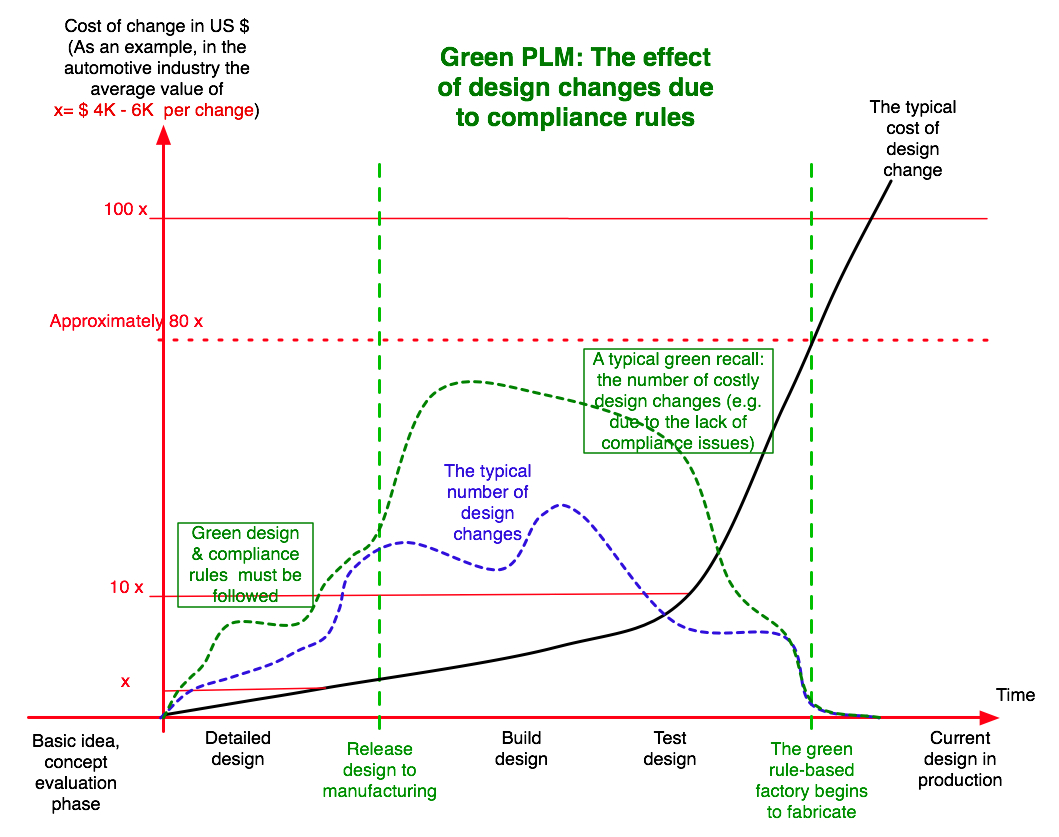
What is green PLM (Product Lifecycle Management)?
As we can see from the graph above, green manufacturing (with a strong green PLM focus) has impressive ROI (Return On Investment) and new revenue creation opportunities.
This is because of the following:
Sustainable, green manufacturing is already effecting every aspect of our life. Since so many methods, processes, designs and systems have to be changed this is only the beginning... It has attracted a wide area of research topics.
These are mainly non-traditional, interdisciplinary areas of research, emphasizing a systems approach to green manufacturing and related fields. Known research subjects include the following:
In practice, in this course, just as in the real world, this means reorganising / redesigning products and manufacturing processes, local and global supply chain processes to achieve environmental outcomes through, resource exchange, recycling, and energy reduction.
Green economy: the bottom line...
Obviously when you are considering saving the environment and producing goods that truly create a sustainable quality life, the first thing opposition claims is, that 'OK, but it must be very expensive!'.
Well, in the long term definitely not... and of course how do you price saving human lives, elderly support and hospitalization expenses, cleanup costs, makor recalls, and others... you cannot and you should not focus on short term gain at human expense...
In terms of one set of facts, this is what the Aberdeen Group has found (February 2008 Report on Green Initiatives: Lowering costs and Increasing Efficiency..., USA):
Of the surveyed financial executives:
These figures are even more important, considering that in the data storage and server market, an important IT / IS aspect of advanced manufacturing, the growth rate in the USA is 27% (2008 figure) annually, whilst the data center energy consumption growth rate is 40% annually (2008 figure).
The Gartner Group finds, that the 'upward-spiraling infrastructure demands and increasing energy costs mean, that the energy proportion of IT costs could double by 2012.'
This calls for advanced real-time energy and reliability monitoring and modeling tools, that can change the nature of data centers from static entities to dynamic 'living organisms' during the next five or more years.
They also found the following:
Some more statistics on financial aspects (Ref.: the Gartner Group, USA):
The key to a meaningful ROI calculation here is to be able to measure infrastructure efficiency at all levels and then add up all numbers for an entire site, as well as for the entire supply chain. Easier said, than done, nevertheless the energy savings are typically around 21% (Ref.: the Aberdeen Group) and even the reliability went up in 58% of the best class companies.
It has also been found by the Aberdeen Group of surveys, that these are the key efficiency enhancing technologies:
Clearly, since every advanced manufacturing company is an advanced IT / IS system too, these data reflect the huge savings as well as gains the greening process can create!
More financial news on renewable energy...
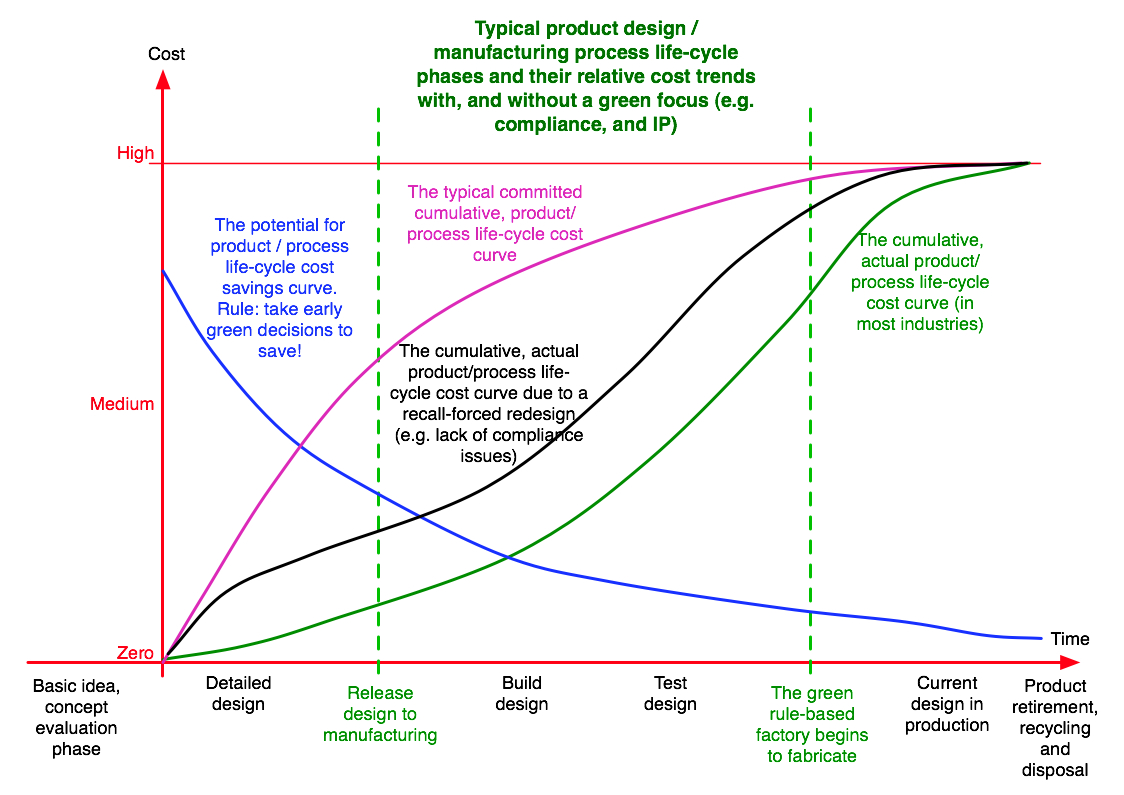
The cost figure below illustrates the huge cost saving opportunities when going green... keep in mind, that in a free economy customers decide what they want to purchase... and the customers in the USA and in Europe are already demanding green products... in large numbers!
As we have seen in the past, recalls due to toxic paint in toys, oil spills, toxic chemicals in factories, and many other challenges in many industries were extremely expensive... and forced major product redesigns; this time with a green focus... but why not in the first place? Consider the huge savings an dcompetitive advantage when designing and manufacturing following green rules...
Greening engineers...
There is something else: the world is short of 'greening engineers'... they must understand international compliance and IP issues... just one specific example:
Ann Arbor Buisness Review in Michigan (USA) Business Innovation blog, Nathan Bomey wrote, "The electrification of the vehicle" needs a "new kind of engineer." This "is such a brand new challenge that it should come at no surprise that the educational system has yet to produce a meaningful number of engineers who can handle these challenges."
The reason why GM must work "around the clock to create the Chevrolet Volt" is because it "hasn't been done before.
" Bomey argued that the "wealth of engineering talent" in southeast Michigan is "a key reason why the engineering services and advanced manufacturing sectors are likely to play a critical role in Michigan's economic turnaround."
Yet, "automotive executives say they are having a hard time finding the kind of engineer that can handle the high-tech challenges presented by the rapid shifts in the industry."
China needs greening engineers too... please read about some new developments in turning China into a greener place... as William McDonough, chief green architect for China states:
' If China carries on with their current rate of urbanization, they'll be left in 2020 with only 20% of their current farmland'... and feeding about 1.5 bllion people is not a small task... (Ref.: http://www.pbs.org/frontlineworld/fellows/green_dreams/, and more here: http://money.cnn.com/magazines/business2/business2_archive/2006/11/01/8392027/index.htm)
The IEEE (USA) Reports the following facts (Ref.: http://newsmanager.commpartners.com/ieeetw/issues/2008-08-27/1.html)
Abundant, cost-efficient energy is the staff of life, economic life, that is.
Whether fired by fossil fuels such as oil, coal and natural gas, or in renewable, that is, sustainable forms, such as wind, solar and nuclear, power makes modern economies – and modern standards of living – possible.
Fossil fuels, however, are disappearing amid tremendous demand from both emerging and industrialized nations. Couple the supply-and-demand equation with the considerable environmental ramifications, and the burning of fossil fuels appears to be simply unsustainable.
A variety of data from around the world underscores the importance of solving the problem:
IEEE research showed that sustainable energy is a very hot topic, reflecting the general public's keen interest in the environment and renewable energy. More than 75 percent of respondents said they were interested in learning more about sustainable energy.
But did you know that:
Ranky's greening architectural framework and generic process plan...
The greening process is a journey, not a destination. It is different for each corporation with some common continuous improvement requirements and risk reduction solutions all the way.
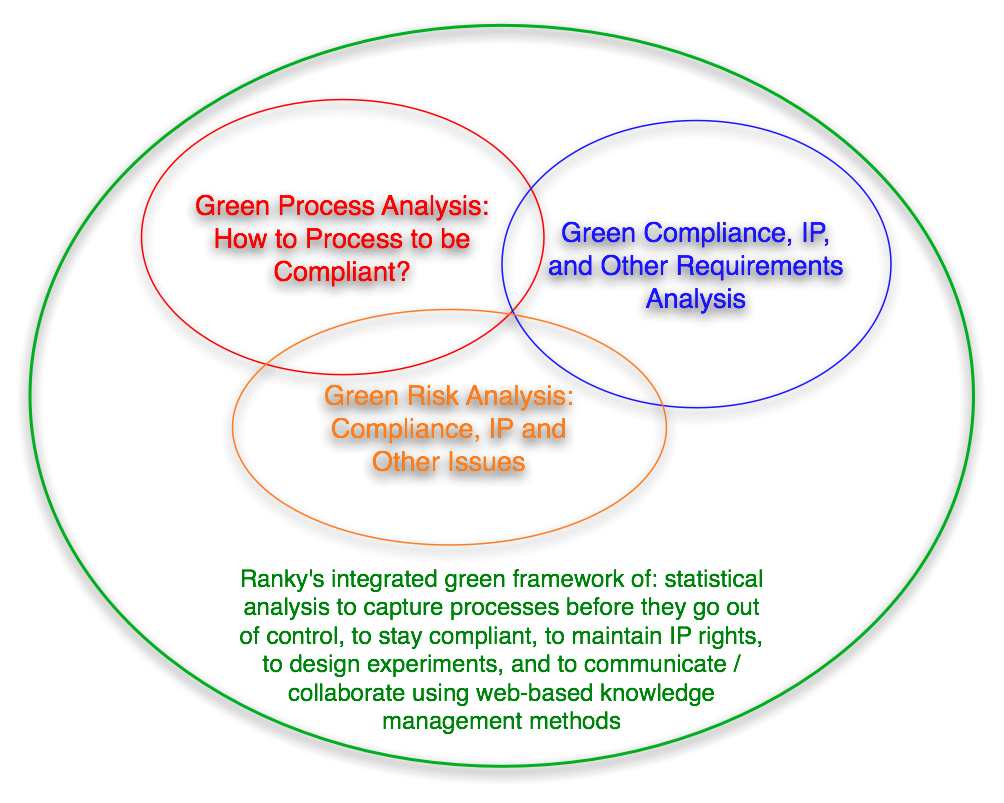
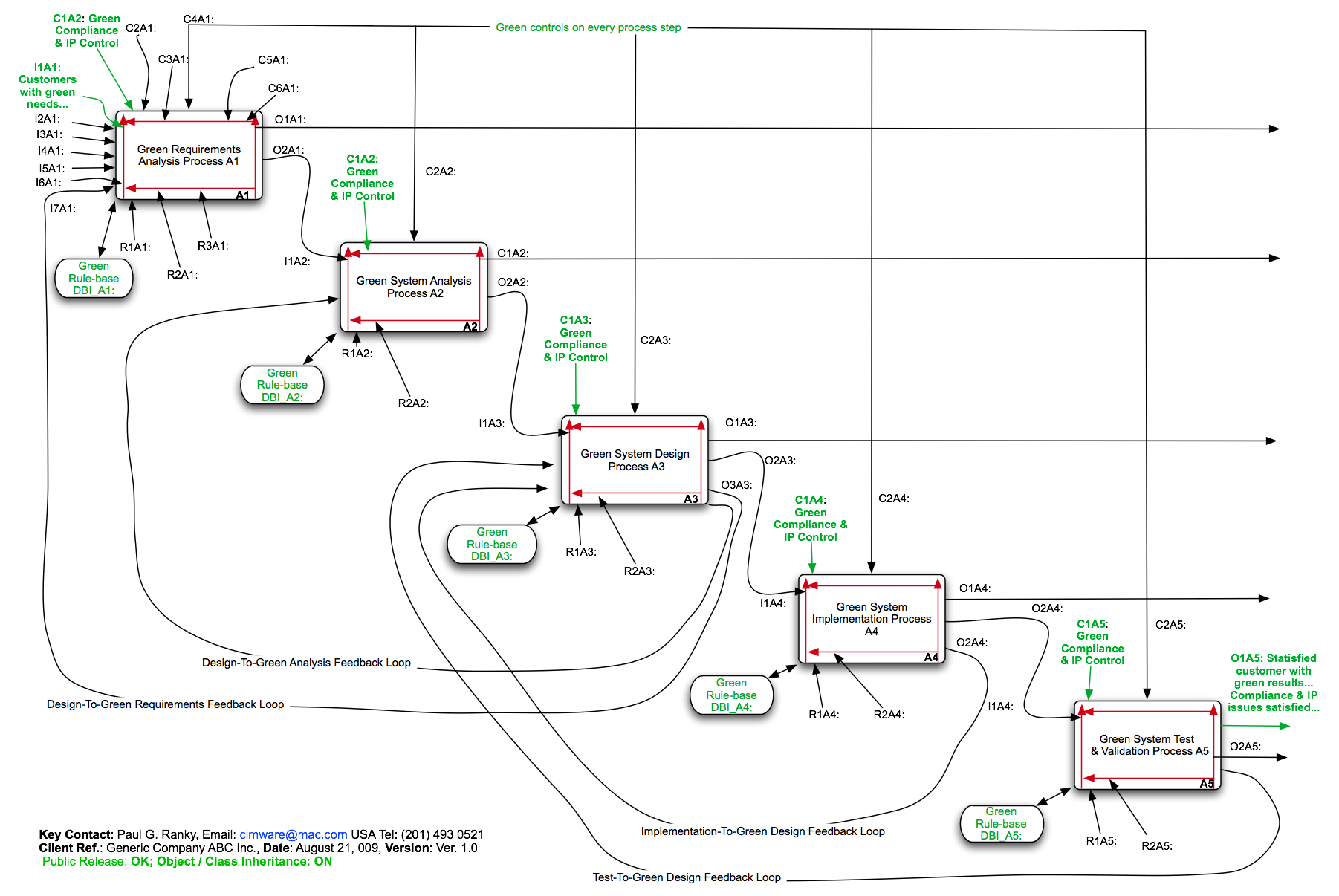
In this course we'll learn some professional object-oriented process modelling methods, that support the engineers and managers in their greening processes following international benchmarks and standards. By following our methods and tools individual processes can be evaluated and changed, if necessary, for green processes, based on customer requirements.
The diagrams below show our overall greening systems architecture, as well as our macro level greening process, following a well established and validated lean six-sigma quality framework.
...and our generic greening process plan...
Examples of greening challenges and use-cases...
Greening products, manufacturing processes and service systems to make them green compliant as the USA, Euroean and many other industries require is not a simple task, nevertheless by following our lean six-sigma focused greening framework and methods we can identify the major process steps, that we need to analyze and fix, in terms of what the customers require, what risks they carry, statistically how they behave, and other aspects.
We show below an example, that has some greening challenges... this is only one of the many use cases and examples we discuss in this course in detail using digital interactive videos, real-world products, and 3D interactive multimedia.
(Just click with the mouse on the poster frame below. The 3D QuickTime application should run. Whilst holding down the mouse on the poster frame move it left and right to enjoy the 3D interactivity... Please note, that to run this example you'll need Apple's cross platform Quicktime player, FREE from the Apple web site www.apple.com. Please note, that at the time of writing these files will not work with any MS media player.)
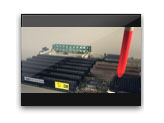
The sustainable greening challenge above includes material selection, lack of design for green manufacture, assembly, disassembly, demanufacturing and recycling processes... this is a typical green PLM challenge but can be solved! This course is about to learn how to solve a problem like this.
To summarize, a successful green manufacturing, and R&D program in any organization will not only lower the impact on the environment, but should also contribute significantly to the bottom line via better energy, hardware and resource management.
Please note, that the 21st Century Engineer must be a professional information searcher, information and knowledge creator, as well as somebody who can reason over several different sets of information and then select the best possible solution path under constraints... You should be able to question, interrogate and take optimal decisions... not an easy task.
As Charles M. Vest, the President of the National Academy of Engineering, and the former President of the MIT, USA puts it (ref.: special guest editorial in the July 2008 Journal of Engineering Education, USA):
'The twenty-first century appears to be quite different, dominated by biology and information, but also by macro-scale issues like energy, water, and sustainability.
...My message here is that the twenty-first century will be very different from the twentieth. Engineering will be enormously exciting, and increasingly rich and complex in its context and importance.
As we think about the challenges ahead, it is important to remember that students are driven by passion, curiosity, engagement, and dreams.
Although we cannot know exactly what they should be taught, we can focus on the environment in which they learn and the forces, ideas, inspirations, and empowering situations to which they are exposed.
Despite our best efforts to plan their education, however, to a large extent we simply wind them up, step back, and watch the amazing things they do. In the long run, making universities and engineering schools exciting, creative, adventurous, rigorous, demanding, and empowering milieus is more important than specifying curricular details.
Nonetheless, I hope that those who design curricula, pedagogy, and student experiences will profitably contemplate the new context, competition, content, and challenges of engineering.'
Also he states:
'The National Academy of Engineering formed a committee of 17 amazingly creative and accomplished engineers and related scientists and medical experts and asked them to define several Engineering Grand Challenges for the decades ahead.
These challenges were to be such that accomplishing them would advance the human condition, and that the committee believed could actually be accomplished in the next few decades.
The committee proposed 14 unranked Engineering Grand Challenges:
• Make Solar Energy Economical
• Provide Energy from Fusion
• Develop Carbon Sequestration Methods
• Manage the Nitrogen Cycle
• Provide Access to Clean Water
• Engineer Better Medicines
• Advance Health Informatics
• Secure Cyberspace
• Prevent Nuclear Terror
• Restore and Improve Urban Infrastructure
• Reverse Engineer the Brain
• Enhance Virtual Reality
• Advance Personalized Learning
• Engineer the Tools of Scientific Discovery'
It is important to realize, that in this course, we introduce and discuss several of the above listed topics.
(In case you have access privileges, please click on the hyperlinks below to reach the topic to be discussed in more detail. Please note, that if you don't have access privileges the hyperlinks will not work.)
1. Introduction to sustainable green manufacturing, and an overview of the course. The key compliance requirements, and business drivers in the USA, in Europe and in Asia. Simultaneously acting constraints, including cost reduction, quality improvement and customer satisfaction requirements, compliance and IP issues, waste and risk reduction, carbon footprint reduction, lean and green sustainability, and others. Reasons why we must green our manufacturing processes and factories on a global basis.
2. The 18 monozukuri principles to design and maintain sustainable green manufacturing processes with industrial examples and case studies captured in the USA, Europe, Japan, and China.
3. A set of analytical methods, computational assessment and statistical tools for evaluating and designing green manufacturing sustainability processes, requirements, and risks. A carbon footprint assessment method and calculator, and an air pollution analysis method and tool. Life Cycle Assessment and Analysis standards and some tools.
4. The sustainable green manufacturing audit process, standards and compliance regulations, outcomes and assessment methods. International green manufacturing standards and compliance. USA and EU compliance audit standards, and mainland China's recycling law, and what it means for sustainable green manufacturing processes, and export / import activities. Relevant ISO and USA standards, and compliance issues. International Chamber of Commerce international trade rules and regulations, the Rio Declaration on Environment and Development. ISO 14001 and sub-standards. The European born Eco-Management and Audit Scheme (EMAS), and the International Organization of Standards 14001 (ISO 14001) and what it means for green manufacturing and international trade.
5. Green materials, including biodegradable materials for green manufacturing processes. The European directive of the Restriction of Hazardous Substances (RoHS) and related compliance issues and constraints that can make a product fail to enter the European market. New USA developments in 'greening' manufacturing and the world. USA compliance issues and restrictions. Also, how can we recycle and reuse materials and make the entire proces sustainable? Industrial ecology to foster the co-operation among various industries whereby the waste of one production process becomes the feedstock for another... in a similar fashion to the way nature works... to identify ways for industry to safely interface with nature, in terms of location, intensity, timing, value added and non-value added processes, and others, to develop measurable and controllable indicators for real-time monitoring (e.g. 24/7 using sensor networks reporting over the Internet), to reduce the energy requirements when converting materials thoughout their entire life-cycle, and others. Long term land use planing within an ecological framework, that identifies, and protects environmental, cultural and historical values, as well as simultaneously becomes profitable for the community.
6. Green rapid prototyping and green rapid manufacturing of product, process, and service systems; Eco-friendly digital design and digital manufacturing engineering principles, methods and analytical tools with several simulation and practical industrial / research case studies.
7. Green flexible automation, green demand-driven manufacturing and plant design, recipe driven green manufacturing in the pharma industry, disposable, biodegradable manufacturing in the pharma industries, disassembly, demanufacturing and recycling methods and technologies, reuse, and others. Best practice sustainable green manufacturing use-cases based on USA, European, Japanese, Chinese, and other international industrial and R&D examples in a variety of industries. The concept of ecological industrial parks, factories, and industrial facilities designed on the basis of ecologically sound symbiosis models. (This is of great value, since industrial symbiosis yields significant reductions in oil, coal and water consumption, as well as reduces carbon dioxide and sulfur dioxide emissions.)
8. Green manufacturing networking and communication / collaboration / video-conferencing processes via the Internet. Smart communities and eco-industrial park networking. Eco-industrial parks are emerging as the primary arena for testing and implementing sustainable green manufacturing within industrial ecology. Similar in some respects to standard industrial parks, eco-industrial parks are designed to allow firms to share infrastructure as a strategy for enhancing sustainable green production and minimizing costs. The distinguishing feature of eco-industrial parks is their use of ecological design to foster collaboration among firms in managing environmental and energy issues. In an eco-industrial park setting, company production patterns, as well as overall park maintenance, work together to follow the principles of natural systems through cycling of resources, working within the constraints of local and global ecosystems, and optimizing energy use. Eco-industrial parks offer firms the opportunity to cooperatively enhance both economic and environmental performance through increased collaboration and networking efficiency, waste minimization, innovation and technology development, access to new markets, strategic planning, and attraction of financing and investment.
9. Internet / intranet-based collaboration and documentation / knowledge management methods, tools and technologies with a sustainable green manufacturing focus. Compliance with international IP and other issues and regulations.
10. International sustainable green manufacturing methods, proceses and R&D case studies focusing on alternative energy resources, applications, and compliant processes.
11. Fuel-cell, wind energy and solar panel manufacturing processes with USA, and international examples. Alternative energy sources: hybrid and fuel-cell cars, electric automobiles and power generators. Technologies to transition from a fossil fuel economy to a hydrogen economy. The emission reduction challenge and compliance issues... Oil, gas, coal, and electricity... transportation, agriculture, industrial and residential emission reduction compliance laws, opportunities, methods and technologies.
12. China-focus: the sustainable green manufacturing challenge in Hong Kong, and the region, as well as in Mainland China. In force as of January 1, 2009, Chinese law states, that governments at all levels should make plans to develop recycling, establish systems to control energy use and pollutant emission, strengthen management on companies with high energy and water consumption, and divert capital into environmentally friendly industries. The recycling law also introduces rewards and penalties for companies, encouraging them to develop recycling by making them responsible for the recycling of their products. What does this mean to green manufacturing, and related service industries in Hong Kong, China, and the region? What are the green manufacturing compliance laws and issues Hong Kong must follow to be able to trade with Europe and the USA?
13. Globally green manufacturing supply chain and logistics network: integration methods, tools and technologies of sustainable green manufacturing and other systems.
14. Sustainable green manufacturing project management challenges, methods and solutions: USA, European, Japanese, Chinese, and other industrial and R&D case studies.
This is a simultaneously analytical, as well as practical course with useful knowledge, that you can turn into 'greening' improvement opportunities in almost any factory, institution, or organization, or system, anywhere in teh world.
As much as possible, we all try to create a relaxed and happy learning environment in this class, and I will try to teach you several new analytical methods and tools, that you can easily deploy in your REAL world, and prosper!
A NEW, and unique feature of this course...
International USA / Hong Kong China / European / Japanese Collaboration between university students and professionals.
As part of an informal academic collaborative effort I set up with several universities, we provide links to international Masters students and their work.
Please feel free to review, comment, and get involved. This is an attempt to increase the global aspects of this course for the benefit of all students and faculty involved both in Hong Kong, China, Asia, as well as in the USA and Europe.
Please let me know if you would like to get in touch with Masters students overseas to work on your assignments together, mimicing a global collaborative greening effort.
Please look up the CityU website for the official dates.
For planning purposes these are the important dates known to us:
Informal Quality Feedback Form (Ranky, August, 2009)
Please review the following topics for this class by rating each topic between 0 to 10 (0 = meaning not important / poor quality and 10 meaning extremely important / excellent!). This feedback form will help your instructor to maximize quality satisfaction.
1. Web-based syllabus (OK it is long, but is it helpful? Did you read it?):
Expect results here in August 2009...
2. Do you prefer interactive, full color learning resources, with active code to calculate with or static, black & white traditional printed books?:
Expect results here in August 2009... 3. Engineering design, manufacturing and management focus on how to find and reduce waste: Expect results here in August 2009... 4. Object-oriented information system models and process modeling Expect results here in August 2009... 5. CORA: QFD (Quality Function Deployment); Requirements Analysis Expect results here in August 2009... 6. Process improvement and process control analysis: quantitative methods: control charts for variables and attributes Expect results here in August 2009... 7. A real-world challenges and examples on digital factory videos, based on virtual tours Expect results here in August 2009... 8. Process -oriented failure risk analysis: PFRA: Process risk analysis Expect results here in August 2009... 9. How the learned methods and tools fit together, and how we can integrate them for specific applications Expect results here in August 2009... 10. Globalization issues: the global greening challenge Expect results here in August 2009... 11. Continuous greening improvement methods and tools illustrated by industrial and R&D case studies Expect results here in August 2009... 12. Any other hot green manufacturing topics we should cover? Please list and explain. Expect results here in August 2009... It is over! Congratulations! You can now analyze and improve many products and services! PLEASE save the TREES! Please DO NOT Print this syllabus. Use this web site to read it in this electronic format; it will be updated during the semester. Thank you!