Note: the URL of the IE673 syllabi (including this one) is at: http://www.cimwareukandusa.com/All_IE673, then click on the version you want to see.
Administrative Issues of this Course
What is in my eLearning Pack this Semester?
Detailed Weekly Schedule of the Course
This is your latest, therefore the most current schedule. Last update: November 20, 2005 (Update history: November 15, September 10, April 20, 2005, August 15, 2005....)
Please Read This! It Contains Vital Information about the Course as well as All the Assignments, Homework and Grades!
PLEASE save the TREES! Please DO NOT Print this syllabus. Use this web site to read it in this electronic format; it will be updated during the semester. Thank you!
The Live, Hybrid and Distance Learning Class: Total Quality Management
Learn About Total Quality Management, Based on a Set of Analytical, Quantitative and Open-source Computational Methods and Tools to Improve Total Quality in Design, in Manufacturing, in IT, in Biomedical Engineering and Various Service Industries. This course introduces the concept of total quality management, and presents methods, tools, technologies and case studies for product, process and service quality improvement. Emphasis is on prevention through quality engineering and design, and goes beyond traditional statistical process quality control. Presentation of recent methods in design, in manufacturing, real-time systems, supplier management, quality assurance, process control, and competitor analysis are included. Includes design of experiments, Taguchi methods, quality function deployment, failure risk analysis, TQM graphical methods, and an in-depth description of ISO 9000 and Baldridge Award; a must for quality audits and certifications.
IE673 is a simultaneously analytical, as well as practical course loaded with useful knowledge, that you can turn into improvement opportunities in almost any factory, institution, or organization.
As one of my former students, Major Jack Parker, US Army, National Guard Bureau, Training Division, Washington, DC states about the course: 'As I developed the assignments, I really could have spent the rest of the year going through the principles and methods I learned in this course. Your course materials provided a great education for me in TQM. I look forward to applying my new knowledge in the Army in every means I find possible and feasible. Thanks again for your great instruction and materials.'
Another former student writes:
' Dear Professor Ranky,
This is Eduardo Canales. I had taken IE_673 last semester with you as part of my master degree in EM. I just want to thank you for such a valuable tool you taught us as it is TQM. Right now, I am working on a matrix evaluation and I remember. I had your Ranky Cora excel tool, which I am using.
The fact that it's in a CD and it's on excel make it practical and fast to use. But not only is the Ranky Cora but all other tools that are in the CD.
Again thanks for your teaching and guidance.
Sincerely,
Eduardo
========
Dear Professor Ranky,
I would like you know that I truly enjoyed your class yesterday. After graduating from NJIT with a degree in CoE I was unable to find a job that I liked and would like to make a career in and felt horrible that I went to school for engineering and came out with pretty much nothing. That was when I decided to look for something in the Finance field and fortunately I was able to land a job, and I like dealing with money and control it has on society. Yesterday’s class made me realize why I did engineering and I was good to know that I didn’t lose the love I had for math, science, inventions.. just engineering in general.
I am looking forward to class next week!
Regards,
Alka
========
[History: Prof Ranky has invited Frank Rick, an inventor and engineer, and holder of 40 (!) US Patents to talk to our class on innovation and quality issues]
... I must say that this class has been very interesting so far and I really enjoyed the speaker last week. Having him come to class and talk about Real Life Experiences is a very rewarding experience that no Professor at NJIT has offered to me during my college experience. I hope we can have a few more?
Thank You
Keith Mueller.
========
Dear professor:
Since I don’t have project management experience, I felt difficult to
get into it in the beginning of this course. After I briefly went
through your eBook, I got some sense. When I read the detail of each
chapter, I found that the course is so practicable, useful and very
attractive. The TQM methods are not just useful in project; they could
be used everywhere, even in living activities. Now I like the course
very much, I believe I have been getting the essence of the course; it
must help me in my career. Thank you very much. I am very appreciated.
Thanks again.
Yours truly,
Haiming Sun.
========
My response: 'I have to admit, that student comments as above make me not just incredibly happy, but also make me work harder every semester to give you the best and latest.'
This is a combined Welcome Letter and Course Outline for both the live, as well as the distance learning class. Please read it carefully. You will find all essential course information here.
Please note, that this document will be updated during the semester. If anything is unclear please contact me.
Paul G. Ranky, PhD
Full Tenured Professor
Registered Chartered Professional Engineer
Department of Industrial and Manufacturing Engineering
NJIT, University Heights, NJ 07102 -1982
Email at NJIT: ranky@njit.edu (Please note, that for reliability reasons I have added another email address: cimware@mac.com . Please use this and send again your email if you don't get an answer from me within 4 working days. I can read the cimware@mac.com account over the Internet anywhere where I have Internet access, therefore even if I am away at a conference we can be in touch.)
Tel at home (in case of an emergency only, 24 hrs, but preferably during normal hours, 8.00 am to 10.00 pm) (201) 493 9561
Note, that my office is in ITC 2519 at NJIT
My office hours for the Fall 2005 semester are 5.00 pm to 6.00 pm on Mondays. Other office hrs. are available unless I am away on official NJIT business. If these are inconvenient hours for you please ask for an appointment by email, or by phone, and I'll be happy to see you as soon as I can.
Find out more about the Professor’s past and current research work and background at:
http://www.cimwareukandusa.com/aboutpgr.htm
Academic Calendar
FALL 2005
Thursday
September 1
First Day of Classes
Saturday
September 3
Saturday Classes Meet
Sunday
September 4
Sunday Classes Meet
Monday
September 5
Labor Day - No Classes Scheduled
Wednesday
September 7
Last Day to Add a Class
Wednesday
September 14
Last Day for a Refund Based on a Partial Withdrawal
Saturday
October 15
Deadline to Apply for January Graduation
Wednesday
October 19
Last Day for a Refund Based on a Complete Withdrawal
Wednesday
November 2
Last Day to Withdraw from Course(s)
Monday
November 7
Spring Registration Begins
Thursday-Sunday
November 24- 27
Thanksgiving Recess-No Classes Scheduled
Monday
December 12
Last Day of Classes
Tuesday-Wednesday
December 13-14
Reading Day - No Classes Scheduled
Thursday-Wednesday
December 15-21
Final Exam Period
Thursday
December 15
Deadline for Applying for May Graduation
Thursday
December 22
Fall Grades Due in Registrar's Office
Thursday
IMPORTANT NOTES TO ALL STUDENTS :
These are the steps my students suggested in the past to follow when uploading webpages to the NJIT server (Note: I use professional servers; I do not use the NJIT server, therefore if you need help please contact the NJIT computing helpdesk, and/or network with other students via the webCT chat groups):
This is a good one, (new version: October 27, 2005) offered by Ashley (thanks!) Click to see it in .html
Last, but not least: ALWAYS test your uploaded assignment using your own, as well as somebody else's computer, to make sure, that everything works fine. (If you don't have a second, independent computer on the web, ask one of your classmates, or friends to check it for you, by sending him/her an email with a full URL in it, like this: http://www.mycoursewebpage.edu).
Also note, that besides the class discussions (live class), the eLearning pack CDs have several examples on the architecture of simple and complex web-pages. All of these are in open source, please study them!
As always,
Happy Learning,
Professor Paul G Ranky, PhD
Welcome to IE673, one of the most useful TQM courses you’ll ever take! Please read these notes. If anything is unclear please call me or email me. I am here to help you! Prerequisite: instructor’s approval.
Narrative Description of the Course: Total quality management is an approach to business involvement led by the theme of quality. It involves the continual satisfaction of customer requirements at lowest cost by harnessing the efforts of everybody in the company. Quality assurance means sustaining a system which prevents defects. This includes quality control and quality engineering. Quality control means establishing and maintaining specified quality standards of products; quality engineering is the establishment and execution of tests to measure product quality and adherence to acceptance criteria.
This course explains the importance of reducing variation for the purpose of implementing total quality in every process of the enterprise. Furthermore, IE673 represents a modular product, process, service design, implementation and management approach to the introduction of various TQM methods, tools, technologies and their management issues within a variety of small, medium and large enterprises.
As often defined "quality is the overall level of product /process / service excellence". It is also quite obvious that without similarly "excellent people, equipment and software" one cannot provide the desired level of quality at the predefined cost. According to Jaguar Cars, "Quality is making money out of satisfying customers. Quality comes first". John F. Akers, former CEO of IBM, defines quality as follows: "Quality is everyone's job. Quality is essential merely to stay in the race". Others claim that: "Quality means putting the customers first every time".
Dr. Akimasa Kurimoto, Yamazaki Machinery states that: "The success or failure of the new business strategies is, in general, attributed to the capability of the company to create its culture in ways that would make the new business strategy work. Quality is a fundamental management philosophy, causing cultural change of mind and attitude. Total quality management is the prime corporate business strategy to facilitate the best blend of management and working practice".
Lucas Engineering & Systems, defines Total Quality as follows: "The term Total Quality of Performance relates not just to the technical quality of products but rather to the quality of performance of every function in an organization. This is in recognition of the fact that the quality and cost of a product depend upon its design, the lead times and the reliability of the processes operated by many contributory departments (both manufacturing and administrative), the choice of materials and the effectiveness of supporting structures".
Mike Robson, international quality expert, claims that: "We all want quality and excellence. Excellence is a journey, not a destination. There is no magic to quality". The conclusion is that every manufacturing (and other) enterprise needs a Total Quality system which is:
The main problems when applying traditional quality management philosophy include the following:
On the contrary, modern thinking claims: because Total Quality Management involves every person, aspect and machine of the organization, it requires a total commitment. It is not a "test and fix" approach. It is a preventive system designed into every aspect of the World Class Design, Manufacturing and Service enterprise, including product design, manufacture, management, etc., (and even in accounting terms costing somewhat less than conventional quality systems, i.e. typically around 10% of the turnover).
In order to learn the above outlined principles, methods, tools and technologies, the course is supported by a comprehensive eLearning package (for both live and distance learning students) with an eTextbook, some printed material, and several web-browser readable, open source 3D interactive multimedia CD-ROMs, and real-world research and industrial case studies on CD-ROMs, as well as open source, professional active code and spreadsheets, that the students can customize when developing their assignments with their own data.
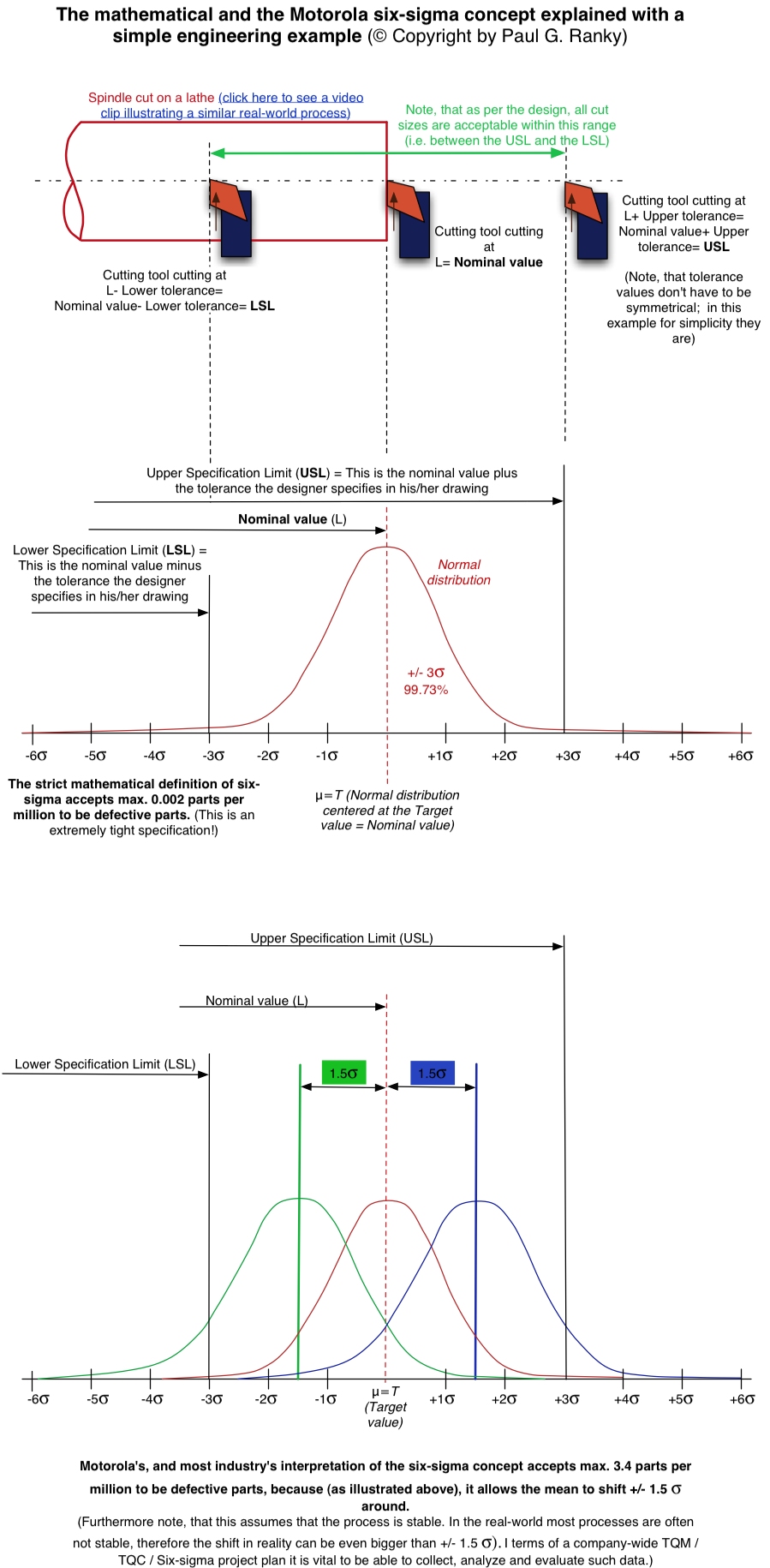
The fundamental goal of TQM and TQC (Total Quality Management and Control) is to program, measure and keep process variability under control. During our studies in this course we discuss several methods, tools and technologies to achieve this goal. One of these methods is identified as six-sigma. In order to give an introductory-level example of our approach, the figure below illustrates the mathematical versus the industrial interpretation of six-sigma. (When reviewing this figure don't forget to play our short sample video, hot-linked to this figure. This is only a short video, because it is run from the server over the Internet. In the eLEarning Pack you'll find several CDs with significant video and multimedia content, including 3D videos!)
To summarize, the methods taught in this course are relevant not just to TQM as applied to design, manufacture, test of products, but to a large variety of services too, because they reduce development costs, and improve working capital management, and increase customer satisfaction by offering powerful methods and software tools.
Upon completing this program of study the candidates will be able to understand and apply TQM Engineering, and related management methods and tools.
Why is the course needed?
There are many methods and solutions to innovate and develop new products and processes, to cut down waste and to improve an organization, a design office, a manufacturing enterprise, a product, or a process. One major discipline is Total Quality Management.
There is no doubt that modern Total Quality Management sounds impressive, but it is also expensive, because it aims at perfection in every aspect of the organization. On the contrary, many large and small companies claim that total quality is a business strategy. It is "a matter of life or death". According to Harold Geneen, of ITT, USA, "Quality is not only free, it's our most profitable product line".
But how can this be true ? As a simple and quick justification process, think for a moment of the fact that following the traditional quality management philosophy, the fewer the faults, the higher the cost, whereas applying a total quality approach, the fewer the faults, the lower the cost.
In other words, modern Total Quality Management means:
It is essential to understand that none of the TQM methods work in practice unless they are applied to all levels of the enterprise, including the internal, as well as external supply chains. TQM methods and the culture of quality has to be introduced gradually and managed by people who understand and support the principles, know how to deal with co-workers, and know the tools.
TQM has its best chance if implemented in a modern, digital factory, in which every major process is monitored, based on analytical, quantitative and computational methods... (more on this topic...)
The table below illustrates the way enterprises must develop, following TQM and integrated product / process and service design principles into international market facing systems, employing knowledgeable and empowered professionals, exactly the workforce this course is developing.
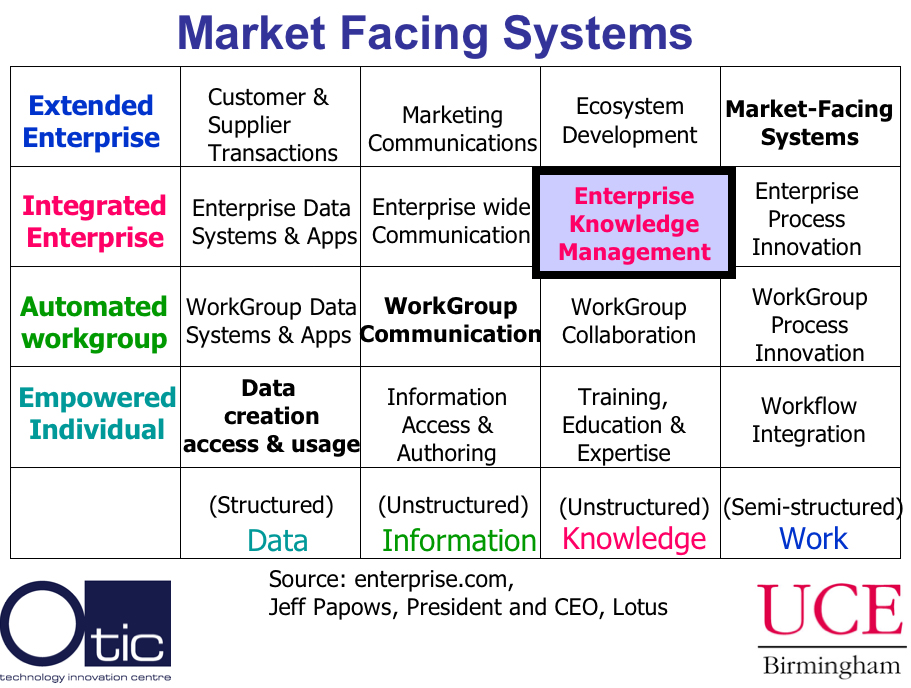
To summarize, TQM address the whole enterprise, including humans and machines, the business systems, product design, process planning, manufacturing planning, the shop floor, packaging, maintenance, and service, for several life-cycles, via the internal, as well as the external supply chains.
For Whom is the Course Intended?
Graduate / Master of Science programs in IE (Industrial Engineering), in EM (Engineering Management), in MnE (Manufacturing Systems Engineering), Pharmaceutical Management, Project Management, as well as an elective course for Graduate Mechanical Engineering, Graduate Computing Science and Graduate Environmental Engineering students. Note, that we follow a modular, Object Oriented (OO) approach that makes the topic very adaptable to a variety of different environments. This approach has been successfully tested and run for several years at NJIT as well as on a consulting basis at large companies, such as IBM, Ford Motor Company, Jaguar Cars, GM/EDS, Boeing, Raytheon, and others.
Furthermore, the course is aimed at graduate research students, professional engineers and managers working in industry, wishing to learn about new, TQM methods, tools and technologies, and management methods, for the purpose of improving products and services.
Live and Distance Learning Students purchase their educationally priced eLearning Packs from the NJIT Bookstore (pls. contact Frank). PLEASE NOTE, that all of the eLearning Pack materials are copyrighted and therefore are for individual use only. You can put selected objects (e.g. images, or video clips, or others up-to-10% of the total content) with proper references to the original material (in the usual format: 'Courtesy of xyz, published by ABC...) into your assignments and post them onto your website, but it is ILLEGAL for you to put an entire eBook (as an example) onto your webpage. I mention this here because some students break the copyright law and therefore can get into major legal trouble; something I do not want you to experience, because it is expensive and nasty...
Every eLearning Pack is different, because it is customized, and includes the following:
The eLearning Packs will give us a great opportunity to work on projects in collaboration with the Four Selected Companies (also in your eLearning Pack). PLEASE NOTE, that each eLearning pack is different, nevertheless the methods we use are the same. Each student should therefore use one eLearning pack. Also note, that you will need a multimedia PC (approx. 500 MHz, with a CD drive and 800x600 resolution screen min., 1024x768 or better screen preferred), a link to the Internet and email, as well as a recent version (not older than yr. 1998) version of MS-Excel in your machine. PLEASE NOTE, that as a student of NJIT, you are entitled to educational software and hardware discounts, and site licenses, therefore make sure that you take advantage of the huge educational discounts offered (even if you work for a company). (See the NJIT's bookstore, as well as contact NJIT's computing help desks at http://njit.edu for further details).
Reading for a degree... A few words about 'reading for a degree'... for hundreds of years, academics and other professionals all over the world emphasized the importance of reading for a degree. Here is a short list of excellent resources that will help you to deepen your understanding in the subject area of this course. Please read more on the subject if you can:
Schedule: This semester is 15 weeks long. You have to complete and submit 6 assignments (see them below in detail). There is no final examination, the course is assessed based on the 6 assignments. The schedule and deadlines for all assignments are below. All assignments should be in electronic format. If there is something not clear, please email, or call, or make an appointment and see me. There is a limited number of rework options (typically one per assignment) to assure that you do your best and learn the most, and of course get the fair grade for your efforts. I am keen to help, but I need your help to be able to help you. Your hard work is the best help for all of us!
Class 1/ NJIT Week 1 (Note that class numbers correspond to the semester week numbers at NJIT). Introduction and overview of the course as well as the subject: What is TQM? Why do we need TQM, and what are the main drivers? TQM in a traditional and in a modern design and manufacturing, and service -oriented enterprise. An overview of the course, the eLearning Pack, and student requirements analysis (i.e. what students would like to learn whilst studying in this course). Part 1: TQM in a traditional and in a modern design and manufacturing, and service -oriented enterprise. An overview of US and international TQM standards. TQM process and enterprise models. Engineering management focus on how to find and reduce quality-related waste, and how to create TQM models, that are analytical, quantitative and computational, as well as have a chance of getting implemented in an enterprise. An overview of modern TQM knowledge documentation and knowledge management methods and issues; An overview of the assignments in this course, and a discussion on what the students have to accomplish to pass this course with a high grade.
Student Activities (this is what you should do to get an 'A' in this class, and most importantly learn the subject):
Class 2 / NJIT Week 2 Part 2: TQM in a traditional and in a modern design and manufacturing, and service -oriented enterprise. International TQM standards. An overview of TQM methods, graphical, statistical and simulation tools and some technologies supporting design, manufacturing and service quality. Object oriented (OO) TQM process and enterprise models are introduced. Engineering management focus on how to find and reduce quality-related waste; and how to create TQM models, that are analytical, quantitative and computational, as well as have a chance of getting implemented in an enterprise. Read Chapters 1 and 2 in the eBook: Label 1: Intro to TQM eBook.
Students present their TQM Project Plans:
Assignment 0: Each student will be given about 5-6 minutes to explain in class, and submit to the instructor a single page executive outline of their project plans! Live students present in class, DL students email to the instructor the way their virtual company (i.e. the 5th company). A one page, executive summary describing the way your virtual company (i.e. the 5th company) will collaborate with the 4 companies (to be found in your customized eLearning Pack) and how will they develop TOGETHER a new quality product, process, or service. (Note: Your product / process, or service you plan to develop MUST be TQM-oriented and you have to spell the TQM aspects out clearly!) (Max. 10%) (This is also a good time to start to set up your webpage...) Also, include your project Title, Author (Name, Class, Date, your eLearning Pack serial number and the collaborative companies you have ( a MUST!). I will respond to this by email, comment and hopefully accept your plans. Note, that in this and other assignments in this course I give you a lot of freedom to innovate. This is why I do not specify every assignment step-by-step in every detail, and treat you as a problem solving machine... I want you to learn to think, act and innovate better and better all the way... I hope you like the idea, because innovation is the ONLY future for us in a global economy... (See our discussions in the TQM eTExtbook CD in detail).
To help you, these are the detailed steps you should take:
Typical Mistakes: Why am I loosing grade points in this assignment?
Classes 3, and 4 / NJIT Week 3 and / NJIT Week 4 US and international TQM standards (goals, architecture, pitfalls, practical implementation issues and rules). Object oriented TQM information system models and process modeling (CIMpgr, object oriented TQM process modeling is explained and discussed through exercises and examples). There are some good articles on CIMpgr at ADAM over the web at http://www.cimwareukandusa.com in the ADAM with IT magazine. Read the case study oriented (CIMpgr) articles and see the OO process model examples. (There is a good overview in the TQM CD, plus there are several templates you can use). You’ll grasp it quickly. You can draw these diagrams with any simple 2D drawing tool, maybe best with VISIO ver. 2003, or CORAL Draw, or Powerpoint, or ADOBE Illustrator, on the PC and OmniGraffle on the Mac in Unix, or others. Please note, that the templates on the eBook CDs are in Visio ver. 2003 format, and since MS has decided to change their file formats for newer versions, we'll add those versions in the next release. Visio ver 2003 is available FREE from the MS website for 1 month, or from NJIT for longer. Read Chapters 3, 4 and 5 in the eBook: Label 1: Intro to TQM eBook.
PLEASE do NOT send me Visio or other source files. Treat me as a global collaborator. I have the web and Excel... and Office... Email me a webpage URL, or in the worst case an MS-Word file with a .jpg image of your models in it.
Submit by the End of Week 4 (note, that 'End of Week', for all cases in this course means Friday, 5.00 p.m. of that week)! Assignment No. 1: A TQM Process / System Modeling Method (as Part of the Internal and External Supply Chain) (After having submitted this to me I’ll make comments on it that you suppose to consider and then rework your assignment). (Max. 20%)
Please note, that the best assignments show evidence that the student has worked through the learning material provided on CD-ROMs, web and in the eTextbook. Therefore feel free to incorporate digital images, text and even video clips or 3D VR objects provided on the CDs into your assignment; nevertheless never forget to credit the source of such objects in the bibliography. In terms of assignment documentation method, please follow the Appendix of the eTextbook CD-ROM in your Learning Pack.
Please follow this structure for your assignment:
Typical Mistakes: Why am I loosing grade points in this assignment?
Classes 5 and 6 / NJIT Week 5 and 6
QFD (Quality Function Deployment); TQM Requirements Analysis is discussed with 3D Virtual Reality examples as an integrated Total Quality Management methodology. Read Chapters 6, 7 and 8 in the eBook: Label 1: Intro to TQM eBook. Watch the MINI-Cooper DVD-Video in your eLearning Pack.
Student Activities:
QFD (Quality Function Deployment) / Requirements analysis is discussed with 3D Virtual Reality examples as a Concurrent Engineering methodology. Focus on the Assignment this week! We like professional quality assignments! Process Improvement and Process Control Analysis, and a Quantitative, Computational Solution: Control Charts for Variables and Attributes. Mathematical modeling with examples. Design of experiments and the extended Ranky/Taguchi method. (You can find this TQM methodology including examples in the TQM eTextbook CD-ROM in your eLearning Pack).
Submit by the End of This Week! Assignment No.2: QFD (Quality Function Deployment; Component Oriented TQM Process Related Requirements Analysis).
Read the main eTextbook of the course, on CD-ROM by Ranky, Paul, G.: An Introduction to Total Quality Management & Control and ...
When developing the QFD1 matrix for a TQM product / process, or service try to put down all
Please note, that the best assignments show evidence that the student has worked through the learning material provided in the eLearning Pack, therefore feel free to incorporate digital images, text and even video clips or 3D VR objects provided on the CDs into your assignment; nevertheless never forget to credit the source of such objects in the bibliography.
Typical Mistakes: Why am I loosing grade points in this assignment?
The integration of quality into every process; An overview of TQM methods, graphical and statistical tools. Read Chapters 10 and 11 in the eBook: Label 1: Intro to TQM eBook.
Submit by the End of Week 10! Assignment (No.3): Process Improvement and Process Control Analysis, and a Quantitative, Computational Solution: Control Charts for Variables and Attributes (Max. 20%)
Select an area in your company, that needs to be improved by employing Process Control methods. Show how a Quantitative, Computational Solution can help. Use Control Charts for Variables and Attributes and make up the missing input data, if necessary.
Read the main eTextbook of the course, on CD-ROM by Ranky, Paul, G.: An Introduction to Total Quality Management & Control and ... as well as the following (early beta versions) of Introduction to Statistical Quality Methods and Open Source Tools:
Text intro. files:
Version: StatToolsIntro_Descr_ver2.doc,
Version: ControlChartVar_Descr_ver3.doc
and for attributes: ControlChartAttr_Descr_ver2.doc, all in Word at present.
Statistical intro. spreadsheets and templates to work with (just click on the filename to download it):
.
.
Version: ContChartVar_Testrun_ver2.xls
Version: ContChartVar_Templ_ver4.xls
Version: ContChartVar_Analysis_ver2.xls
.
pChartConstantSize_testrun_ver2.xls
pChartConstantSize_templ_ver2.xls
..
pChartVartSize_testrun_ver2.xls
.
.
.
Please note, that all above are still Beta versions... AND as promissed, if you find a bug, you'll get extra 10% to your grade! Also, we welcome any suggestions. The docu. is still not good enough, but Fanny and I are working on it... As an alternative, you can use a pro tool: MINITAB. The benefit of our simple toolset is that you get the source code. Enjoy!
Typical Mistakes: Why am I loosing grade points in this assignment?
Class 9 / NJIT Week 9 (Please note, that during the Spring Break we don't have a class, nevertheless students are requested to study the identified areas, as described below, using their eLearning Packs).
The Lean Six Sigma Methodology for TQM in Design, Manufacturing, Assembly and Service. An overview of Design For Quality, Assembly, Disassembly, the role of Quality Standards and Quality Circles, and other TQM methods, with 3D Virtual Reality examples and classroom exercises. Read Chapters up to 13 in the eBook: Label 1: Intro to TQM eBook.
JIT and Kanban (Lean) production control methods for design, manufacturing, assembly and service quality Improvement. TQM tools. Networked TQM and TQC in collaborating digital enterprises, and the role of modeling and simulation; Quality leadership, strategic management, and customer satisfaction issues; Globalization, and quality culture issues; Teamwork and how to build great quality teams;
Classes 11 and 12 / NJIT Week 11 and Week 12
The Importance of quality in management, in service industries. Quality communication skills, education, training and TQM knowledge documentation and knowledge management methods and tools; Quality Ethics, TQM culture, benchmarking and globalization; Continuous quality improvement methods and examples.
Based on the Industrial Case Study CD-ROM:
Focus on the TQM engineering related challenges/ questions in this CD. Try to answer 10 selected questions of your choice! Incorporate these answers into the Assignment below!
Submit by the End of This Week! Assignment No.4: The focus of this assignment is: Process Failure Risk Analysis, as Part of an Industrial TQM Process Improvement Study Based on our PFRA Method and Tool (Max. 20%) Read Chapter 9 in the eBook: Label 1: Intro to TQM eBook.
As you prepare for this assignment, read about Process Failure Risk Analysis, closely related to a method also known as FMEA, Failure Mode and Effects Analysis. (You can find this in the main eTextbook of the course, on CD-ROM by Ranky, Paul, G.: An Introduction to Total Quality Management & Control and ...).
For the Industrial Case Study, use the 'This is Where the MINI is Made (A Virtual Video Factory Tour)...' DVD in your eLearning Pack.
Typical Mistakes: Why am I loosing grade points in this assignment?
Class 13 / NJIT Week 13 (It's almost over... just a few days left...)
TQM audit. Course summary and overview: How the learned methods and tools fit together, and how we can integrate them for specific applications.
Class 14 / NJIT Week 14: TQM Audit and How to Improve a Selected, Industrial System: TQM in a Global, Distributed, Just-in-time, Digital Economy using the learned methods and technologies, including RFID. Read the remaining Chapters in the eBook: Label 1: Intro to TQM eBook, and watch the RFID DVD-Video.
Submit by the End of This Week! Assignment No.5: TQM Audit and How to Improve a Selected, Industrial System using RFID / TQM methods: TQM in a Global, Distributed, Just-in-time, Digital Economy (Max. 20%). In terms of a guide on how to do this, use the already discussed eight ISO 9000:2000 quality principles.
Class 15: LAST CLASS!!!! Assignment Reviews / Discussions This Week! We'll discuss any questions you have. For DL students please contact me by email, or phone, or see me in person (please make an appointment in advance via email; thanks).
12.00 pm, December 15, 2005 = ABSOLUTELY THE LAST DAY TO SUBMIT any new or reworked assignments! All submissions MUST be electronic = by email / web.
Schedule and due dates: As above. The total course duration is 15 weeks. Students will be required to complete each assignment. Assignments totaling 110% max. Grade "A" for this class requires min. 92% total. Note, that we don't have a Midterm or a Final exam, because of the integrated nature, the computational requirements, and the research contents of the customized assignments, BUT you must complete Assignments 0, 1 and 2 by around Midterm (see above) if you want to get an 'A', and the rest by the end-of-semester deadline (see above) at a high quality. Thank you for helping me to be able to help you!
The Results of the Anonymous Total Quality Feedback Form: IE673 (January 23, 2003)
Please rate the following topics planned to be covered in this class by rating each topic between 0 (not important / poor) and 10 (extremely important / excellent!) on the right hand side of the sheet please!
This feedback form will help your instructor to dynamically adjust the breath and the depth of the topics to be covered in this semester in this class to maximize your level of quality satisfaction.
Topics (as per the web-based syllabus) Your rating (0 -> 10)
Web-based syllabus (TQM improvement opportunity: most students haven't seen the syllabus at the time we have started the class... Solution: NJIT should put the live course syllabi (prepared by faculty) with a hot link to the course registration page on the web too... the DL course syllabi are already hotlinked to the web, and this system works reasonably well)
eLearning Pack (Because of the above, the students did not know about the eLearning Packs)
What is TQM? Why do we need TQM, and what are the main drivers? TQM in a traditional and in a modern design and manufacturing, and service -oriented enterprise. (Rated: Very High)
TQM in a traditional and in a modern design and manufacturing, and service -oriented enterprise. (Rated: Very High).
An overview of US and international TQM standards (Rated: High).
TQM process and enterprise models. (Rated: High).
Engineering management focus on how to find and reduce quality-related waste, and how to create TQM models, that are analytical, quantitative and computational, as well as have a chance of getting implemented in an enterprise. (Rated: Very High).
An overview of modern TQM knowledge documentation and knowledge management methods and issues. (Rated: Medium)
An overview of the assignments in this course, and a discussion on what the students have to accomplish to pass this course with a high grade. (Rated: Medium).
Object oriented TQM information system models and process modeling. (Rated: Medium)
QFD (Quality Function Deployment); TQM Requirements Analysis is discussed with 3D Virtual Reality examples as an integrated Total Quality Management methodology. (Rated: High).
Process Improvement and Process Control Analysis, and a Quantitative, Computational Solution: Control Charts for Variables and Attributes. Mathematical modeling with examples. (Rated: High).
The Lean Six Sigma Methodology for TQM in Design, Manufacturing, Assembly and Service. (Rated: High).
The Five 'S's explained with examples (i.e. Sort, Set, Shine, Standardize, Sustain). (Rated: High).
An overview of Design For Quality, Assembly, Disassembly, KANRI, KAISEN, MUDA, MURA, MURI, POKA-YOKE. (Rated: Medium; nevertheless many students did not know what this meant, so we'll discuss these methods)
The role of Quality Standards and Quality Circles. (Rated: High)
A real-world TQM challenge, based on a virtual tour of an existing facility. (Rated: High)
JIT and Kanban (Lean) production control methods for design, manufacturing, assembly and service quality Improvement. (Rated: High)
TQM tools. (Rated: Very High)
How the learned methods and tools fit together, and how we can integrate them for specific applications. (Rated: Very High)
TQM team management methods and issues. TQM in the automotive, aerospace, food, service, medical, and other TQM standards re-visited. (Rated: High).
Quality ethics. Enterprise -wide quality leadership, implementation and management methods. (Rated: Very High).
Globalization issues. (Rated: Medium)
TQM cultural issues; Conflict in the workplace, and how TQM methods and principles can help to avoid them. (Rated: High)
Continuous improvement methods and cases. (Rated: Very High)
TQM project presentation skills. (Rated: High).
Industrial and R&D Case studies for every topic (as listed above). (Two groups have emerged: one rated Very High, the other one Medium)
Any other topic you would like to cover? Please explain. (Received none, meaning, that the class is happy with the offered topics)
It is over! Congratulations! You can now analyze and improve many products and services!
PLEASE save the TREES! Please DO NOT Print this syllabus. Use this web site to read it in this electronic format; it will be updated during the semester. Thank you!